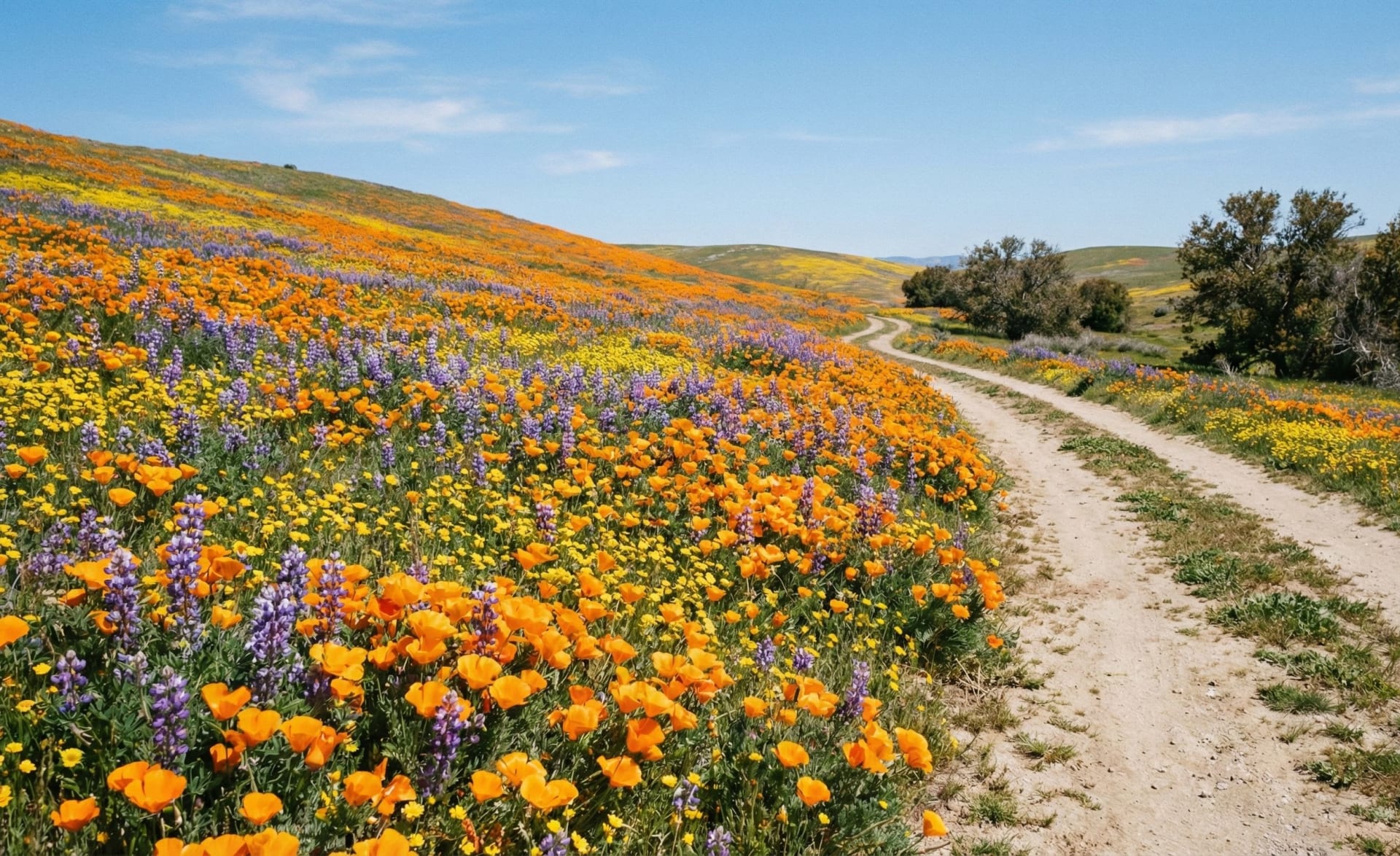
The first thing that hits you is the color. Not a gentle wash of pastels easing into view, but a violent, almost electrical orange flooding the valley floor from ridge to ridge. You round a bend on a desert highway you have driven a dozen times before, and the landscape you thought you knew has been replaced by something that looks manufactured, impossible, like someone tilted a paint can across the entire Mojave. Then the wind shifts and you catch the faint sweetness of a million open throats of pollen, and your brain finally accepts what your eyes are reporting: the desert is alive.
The Science of Sleeping Seeds
A California superbloom is not a scheduled event. It is a biological lottery, and the ticket was purchased years, sometimes decades, ago.
The seeds are already there. Buried in the top few inches of desert soil lies a reservoir biologists call a seed bank. Species like California poppy (*Eschscholzia californica*), desert sunflower (*Geraea canescens*), sand verbena (*Abronia villosa*), and desert lily (*Hesperocallis undulata*) drop seeds that can remain viable in a dormant state for 10, 20, even 30 years, waiting for precisely the right chemical and thermal signals to germinate. The desert floor beneath your feet on any dry, unremarkable July afternoon is loaded with potential.
What unlocks it is a specific sequence of weather. Rainfall must reach roughly 150% or more of the seasonal average, and it must arrive during the right window, typically October through February. Too early and the seedlings get scorched by lingering heat. Too late and there is not enough growing time before spring temperatures spike. The rain also needs to come in pulses rather than a single deluge, allowing the soil to absorb moisture deeply rather than shedding it as flash floods.
After the rain, warm spring temperatures in March and April trigger rapid germination. The annuals race through their entire life cycle in weeks. They germinate, grow, flower, get pollinated, set seed, and die, all before the summer heat returns. It is a compressed, frantic existence, and the visual result is staggering. In strong superbloom years, satellite imagery from NASA has captured the color shift from space, as it did during the massive 2019 event.
Because the required conditions align so rarely, major superblooms occur roughly every 5 to 10 years. Minor blooms happen more frequently, but the full-scale eruptions that turn entire valleys orange and purple are genuinely irregular. No one can predict them more than a few weeks out with certainty. You watch the rain totals through winter, you monitor soil moisture reports, and you wait.
When and Where to Find It
The core superbloom window runs from mid-March to mid-April, though early scouts can appear in late February at lower elevations and stragglers persist into early May at higher sites. Elevation matters. Blooms start in the low desert and move uphill as temperatures warm, so timing your visit to the right altitude on the right week is the difference between a carpet of flowers and a carpet of dirt.
Anza-Borrego Desert State Park (33.258N, 116.406W) is the most reliable superbloom location in the state. Its vast bajadas and washes collect runoff efficiently, and the park's 600,000 acres mean that even in modest bloom years, something is flowering somewhere. The desert sunflower and sand verbena dominate here, painting swaths of yellow and purple across the sandy flats. The park allows dispersed camping, so you can wake up inside the bloom.
Antelope Valley California Poppy Reserve (34.725N, 118.397W) is the poppy specialist. When conditions align, the rolling hills northwest of Lancaster turn solid orange with *Eschscholzia californica*. Poppies are light-sensitive and close their petals on overcast days and at night, so you need sun and warmth for the full display. A gray morning here can look like nothing, then by noon the hillsides ignite.
Carrizo Plain National Monument (35.190N, 119.863W) is the connoisseur's pick. Remote, uncrowded, and home to the most diverse wildflower mix of any superbloom site. You will see goldfields, tidy tips, phacelia, and owl's clover alongside the usual players. The Soda Lake overlook in a strong year is one of the most surreal viewpoints in North America, with concentric rings of color surrounding the alkaline lakebed.
Death Valley National Park near Furnace Creek (36.458N, 116.871W) and Joshua Tree National Park (33.873N, 115.901W) both produce blooms in strong rain years, though they are less consistent than Anza-Borrego. Death Valley's advantage is the contrast: vivid wildflowers against salt flats and barren alluvial fans.
Practical friction you should know about: Cell service at Carrizo Plain and much of Anza-Borrego is nonexistent. Download offline maps before you leave pavement. Gas stations are sparse in all of these areas. Fill your tank completely before entering any of these parks. The 2019 superbloom drew such enormous crowds to Walker Canyon near Lake Elsinore that authorities closed the site entirely, and the phrase "poppy apocalypse" entered the lexicon after drone footage showed thousands of visitors crushing flowers underfoot for social media photos. Plan for weekday visits if possible. Arrive before 8 a.m. on weekends or accept that parking lots will be full.
Witnessing and Photographing the Bloom
Bring water, sun protection, a hat, sunscreen, sturdy hiking shoes, snacks, a full gas tank, and offline maps. The desert in March is pleasant but deceptive. Temperatures can swing 30 degrees between morning and afternoon, and there is no shade.
For photography, morning golden hour is the prime window, particularly for poppies, which have not yet fully opened at dawn and present elegant, half-curled shapes against warm sidelight. By midday the light is harsh but the flowers are fully open, which works for wide establishing shots.
Get low. The single most effective technique for superbloom photography is dropping to eye level with the flowers. A field of poppies photographed from standing height looks flat. The same field photographed from six inches off the ground, with a wide-angle lens, becomes an ocean of color with depth and dimension receding toward distant mountains.
Use a polarizing filter to deepen blue skies and reduce glare on waxy petals. For close-up work, focus stacking (combining multiple shots at different focus distances) will keep both the nearest bloom and the background sharp. A telephoto lens in the 70-200mm range lets you compress distant flower fields, stacking layers of color that appear denser than they look to the naked eye.
Overcast days are not wasted days. Cloud cover produces soft, diffused light that saturates colors without the blown highlights and harsh shadows of direct sun. Purples and magentas in particular look richer under clouds.
Stay on established trails and roads. Desert soil crusts, called cryptobiotic crusts, are living communities of cyanobacteria, fungi, and mosses that take decades to form and seconds to destroy under a boot. The flowers themselves are equally fragile. One footprint in a dense patch kills dozens of plants and the seeds they would have contributed to the next bloom cycle. Use telephoto lenses to capture intimate details from the trail rather than wading into the flowers. The 2019 damage at Walker Canyon was measurable in subsequent years as trampled areas showed reduced germination.
The Bigger Picture
Superblooms sit at the intersection of climate, patience, and chance. They are a visible reminder that desert ecosystems are not barren. They are waiting. The seed bank beneath the surface represents an evolutionary strategy refined over millions of years: invest in dormancy, explode when conditions allow, then retreat.
Climate models suggest that precipitation patterns in the American Southwest are becoming more variable, with longer dry stretches punctuated by more intense wet events. Whether this increases or decreases superbloom frequency is an active area of research. Some ecologists argue that more intense winter rain events could trigger more frequent blooms. Others point out that rising spring temperatures may shorten the growth window, reducing bloom density even when rain totals are adequate. Invasive grasses, particularly Mediterranean species like red brome, are also colonizing desert floors and competing with native annuals for moisture and space.
What is certain is that each superbloom is a snapshot of conditions that will not repeat identically. The specific mix of species, the density, the timing, the way the color shifts from valley to valley as different species peak on different days, all of this is a one-time configuration. The desert will bloom again. It will not bloom exactly like this again.
If you are watching winter rainfall totals climb above normal this year, start planning. Monitor desert wildflower reports from Anza-Borrego and the Theodore Payne Foundation in late February. When the reports shift from "promising" to "confirmed," you will have a two-to-three-week window to get there before the heat ends it.
Track live conditions for this and 590+ phenomena on the Earth Exhibit app: https://earthexhibit.com
Track This Phenomenon Live
The Earth Exhibit app monitors real-time conditions for this and 590+ natural phenomena worldwide. Get alerts when conditions peak near you.
