As of Jun 17, 2026, 4:21 PM, happening now. Earth Exhibit tracks the live conditions and flags it the moment it is on.
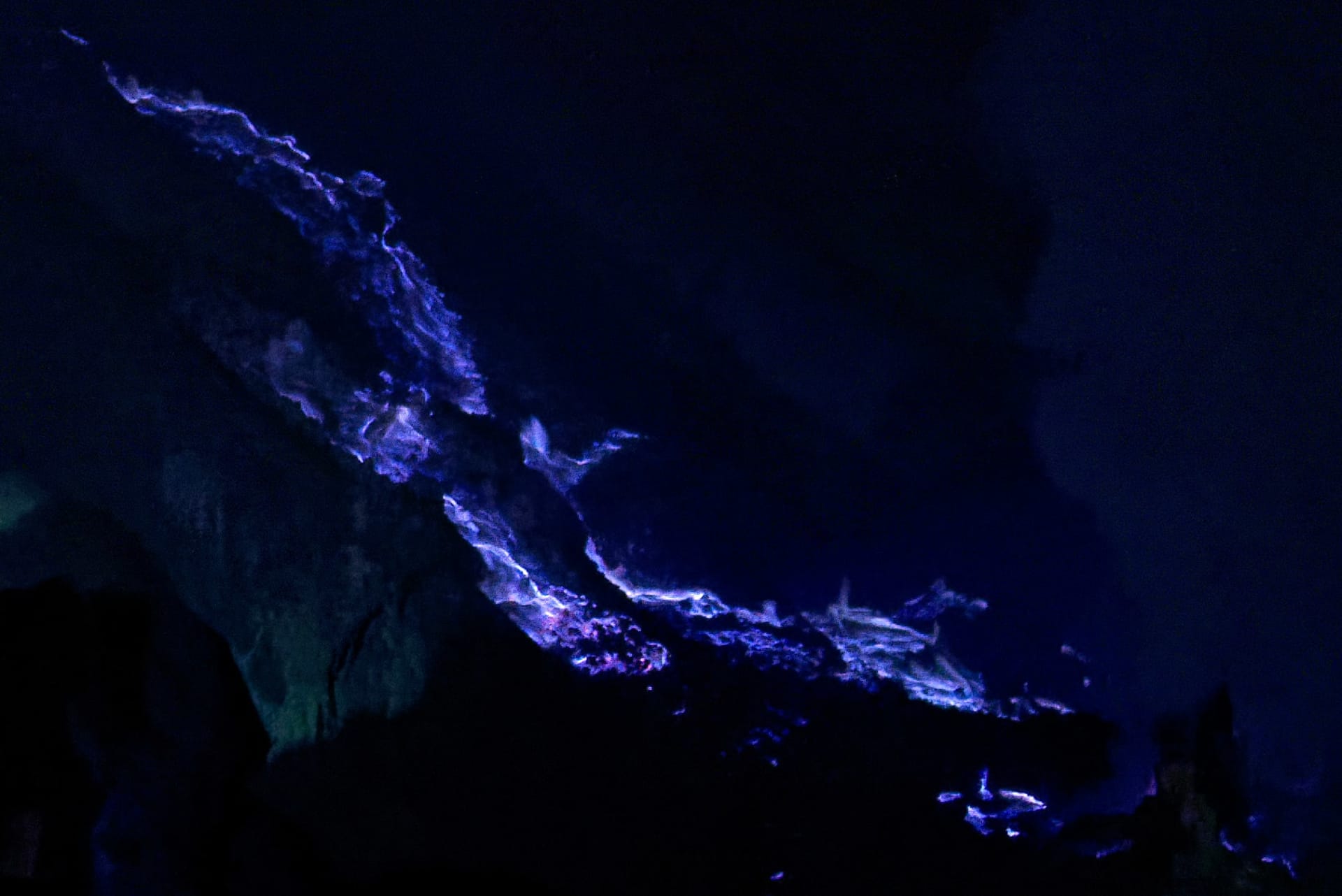
The trail ends and the crater drops away beneath your feet. It is 1:40 in the morning on the rim of Kawah Ijen, East Java, and you cannot see the bottom. Then your guide points down and to the left, and there it is: a river of blue fire pouring over black rock in complete silence. No rumble, no crackle. Just electric blue light sliding downhill like something spilled from a furnace on another planet. Your eyes keep trying to make it orange. It stays blue.
You pull your gas mask tighter. The sulfur smell has already gotten through.
What You Are Actually Seeing
Here is the critical thing: this is not lava. The blue flames at Kawah Ijen are burning gas, not molten rock. Deep inside the volcano's fumaroles, sulfuric gases (primarily sulfur dioxide and hydrogen sulfide) build up at temperatures exceeding 600 degrees Celsius. When these gases escape through cracks in the crater wall and meet atmospheric oxygen, they ignite. The resulting combustion burns with blue and violet flames that can reach five meters tall.
The illusion of flowing blue lava comes from a secondary process. Some of the sulfur gas condenses into liquid before it fully combusts. This molten sulfur, still burning, runs downhill along the rocky terrain. In the dark, it looks exactly like lava flowing in an impossible color. During daylight the flames become almost invisible, which is why every visit happens between midnight and dawn.
Beneath all of this theater, the actual magma inside Kawah Ijen is perfectly ordinary basaltic-andesite. Red-orange. Unremarkable. The blue phenomenon exists only because of the extreme concentration of sulfur venting through the crater's fumarole system, one of the most sulfur-rich on Earth. Only one other location, Dallol in Ethiopia's Danakil Depression, produces anything visually comparable, and Dallol's version is far less accessible and less intense.
The chemistry is straightforward. Hydrogen sulfide oxidizes on contact with air: 2H2S + 3O2 produces 2SO2 + 2H2O, releasing energy as blue-spectrum light. The color comes from the emission wavelength of excited sulfur dioxide molecules, peaking around 350 to 450 nanometers. Your camera sensor interprets this differently than your eyes do, which makes photographing the flames a specific kind of challenge.
The Crater Lake Nobody Prepared You For
The blue flames share their crater with something equally extreme. Kawah Ijen holds the world's largest hyperacidic volcanic lake, a one-kilometer-wide pool of water with a pH hovering around 0.5. For reference, battery acid sits at about 1.0. The lake's turquoise color comes from dissolved metals (aluminum, iron, manganese) suspended in sulfuric and hydrochloric acid at concentrations that would dissolve a steel nail in hours.
At sunrise, after you have watched the blue flames fade with the dark, the crater lake reveals itself. The water is a milky, almost artificially vivid turquoise, bordered by banks of bright yellow sulfur deposits. Steam drifts off the surface. The visual contrast of the yellow, white, and blue-green is so sharp it looks composited. It is not.
The lake's temperature stays around 40 degrees Celsius at the surface but reaches close to 200 degrees at its volcanic vents below. Roughly 240 million cubic meters of acid water sit in this basin. During periods of heavy rain, the lake can overflow, sending acidic runoff into rivers downstream that has historically killed fish and damaged crops in the Banyupait River valley.
When and Where to Go
Kawah Ijen sits on the eastern tip of Java, Indonesia, in the Banyuwangi Regency of East Java province. The coordinates are 8.058S, 114.242E. The nearest town is Banyuwangi, reachable by train from Surabaya (about six hours) or by a short ferry from Bali's west coast at Gilimanuk.
The blue flames burn year-round. They are not seasonal. However, access conditions vary significantly:
April through October (dry season) is the standard recommendation. The 3.5-kilometer trail from the Paltuding post to the crater rim stays relatively firm. Visibility is better. The sulfur gas, while always present, disperses more predictably.
November through March (wet season) brings rain that turns sections of the trail into slick mud, and the park sometimes closes during heavy downpours. The gas can pool in the crater during low-wind conditions, making descent more hazardous.
The hike itself starts from the Paltuding ranger station at around 1,850 meters elevation and climbs to the crater rim at approximately 2,386 meters over roughly 90 minutes. From the rim, the descent into the crater takes another 30 to 45 minutes on a steep, rocky path with no railings and loose footing. Most guided groups depart Paltuding between midnight and 1:00 AM to reach the crater floor while the flames are most visible and allow time for the sunrise over the lake.
One reality check: the descent path into the crater is not maintained in any meaningful way. Rocks shift. The path narrows. You are walking down in the dark with a headlamp, surrounded by sulfur gas, on terrain that miners use barefoot. A quality gas mask is not optional. The disposable surgical masks sold at the trailhead do almost nothing against sulfur dioxide. Bring a proper mask with activated carbon filters, or rent one from a reputable guide service in Banyuwangi.
Entry to the Ijen Crater costs approximately 100,000 IDR for foreign visitors (roughly $6 USD). Guides are technically optional but strongly recommended for the crater descent, especially at night.
Photographing Blue Fire and Acid Water
The blue flames are among the most technically demanding natural phenomena to photograph well. They are bright enough to see clearly with the naked eye but occupy a narrow slice of the visible spectrum that digital sensors struggle to render accurately.
For the flames (pre-dawn darkness):
- Shutter speed: 2 to 10 seconds. Shorter exposures freeze the flame shapes but need higher ISO. Longer exposures capture the flowing movement of burning sulfur but risk overexposing the brightest points.
- Aperture: f/2.8 to f/5.6. Open wide for dim conditions, but not so wide that depth of field becomes paper-thin on the uneven terrain.
- ISO: 1600 to 3200. Push higher if needed, but noise compounds fast in the blue channel.
- Lens: Wide-angle (14 to 24mm equivalent) to capture the scale of the crater. A 35mm works if you want tighter compositions of individual flame vents.
- Focus manually. Autofocus hunts endlessly in these conditions. Set focus to a fixed point using your headlamp on a nearby rock, then lock it.
- Tripod is essential, but choose your placement carefully. The ground near active vents radiates heat, and sulfuric gas corrodes metal. Keep your tripod legs away from direct vent output. Bring a plastic bag to cover your camera body between shots. The corrosive gas will, over time, damage lens coatings and eat into metal parts. Several photographers have reported accelerated wear on equipment used repeatedly at Ijen.
- Shoot RAW. JPEG compression destroys the subtle gradations between deep blue, violet, and the yellow sulfur reflections.
- Video captures flame movement far better than stills. If you have a second body or a phone with manual video controls, set it recording while you work your stills camera.
For the crater lake (sunrise): Switch to standard landscape settings. The turquoise water against yellow sulfur banks is high contrast. Bracket your exposures. A polarizing filter cuts the steam glare and deepens the water color. The best light hits the lake between 5:30 and 6:30 AM, depending on season.
If sulfur miners are working (they start before dawn, carrying 70 to 90 kilogram loads of solid sulfur in baskets balanced on bamboo poles up and out of the crater), ask before photographing them. Most are willing. Some expect a small tip, which is fair given that you are photographing their workplace, a place where the average life expectancy of a long-term miner drops significantly due to chronic respiratory damage from sulfur exposure. They earn roughly $5 to $13 USD per trip. Some make two trips per day.
A Volcano That Works People to the Bone
Kawah Ijen is not a pristine wilderness viewpoint. It is an active industrial site layered on top of an active volcanic system. The sulfur mining operation has run for over a century. Miners crack solidified sulfur from the fumarole deposits with steel bars, load it into baskets, and carry it up 300 meters of crater wall on a path you will find difficult with nothing on your back.
The blue flames that tourists travel to see are the same gas vents that slowly destroy these workers' lungs. Some miners use the tourist headlamps to navigate. The economies overlap in uncomfortable ways. Tour fees contribute to park maintenance and local employment in Banyuwangi, and some miners now supplement their income by guiding visitors or selling small sulfur souvenirs shaped into figures at the crater rim.
Indonesia's Center for Volcanology and Geological Hazard Mitigation monitors Ijen continuously. The volcano's alert level fluctuates. In 2018, a sudden increase in gas emissions forced temporary closures. Phreatic eruptions (steam-driven explosions from the lake) are a known risk, though the last significant one occurred decades ago. Always check the current alert status before your visit through the local tourism office in Banyuwangi or the PVMBG website.
The blue flames will burn as long as sulfur vents from Ijen's magmatic system, which means they are functionally permanent on any human timescale. The crater lake will stay acid. The miners will keep climbing until economics or regulation changes their calculus. What you witness at Kawah Ijen is geology, chemistry, human labor, and raw volcanic energy compressed into a single dark crater, all of it lit blue from below.
This is the short version
This page shows a taste. The app has the full list of where to see this, the exact timing, and live conditions for 1,000+ natural phenomena worldwide, so you know the moment one is genuinely worth the trip.