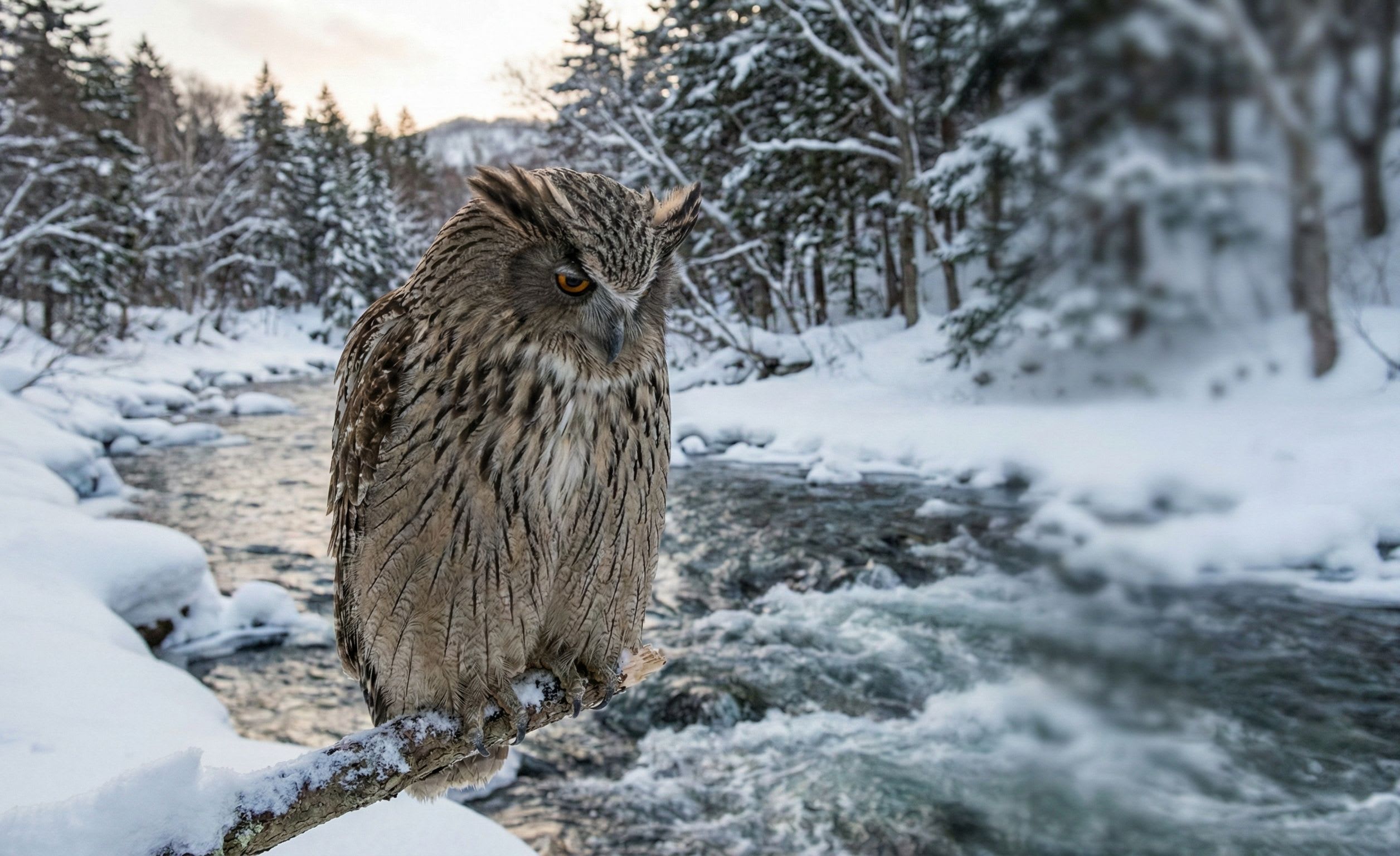
The river is black glass at 6am. Then the shape drops from the treeline, and you understand what mass means. Blakiston's fish owl (Bubo blakistoni) measures 70 centimeters beak to tail, but it is the wingspan that stops you cold: 180 centimeters of straw-brown feathers descending toward open water. The owl's ear tufts angle forward as it scans the shallows, talons extended, hunting for salmon in the ice-free pockets of the Chitorai River. Rausu, on Hokkaido's Shiretoko Peninsula, holds one of the world's last reliable populations of this critically endangered raptor. January through February is when the rivers concentrate, the fish slow, and the owls hunt in daylight.
The Science Behind Blakiston's Fish Owl
Blakiston's fish owl is the largest living species of owl, a sub-group of eagle-owls that specialize in hunting in riparian areas.
Males weigh from 2.95 to 3.6 kg, while females reach up to 4.6 kg, about 25% larger. This is not a bird built for silent forest hunting. It is built for rivers.
It feeds mainly on fish, including salmonids such as pink salmon, char, and Dolly Varden, along with lampreys, loaches, frogs, and occasionally birds or small mammals. The owl hunts by perching on streamside branches or wading directly into shallows, striking fish with unfeathered talons adapted for gripping slippery prey. Mated pairs perform deep, resonant duet calls that can carry over a kilometer through the forest night. The male's call is a low, booming hoot; the female answers with a higher-pitched response. During breeding season in February and March, these calls intensify as pairs defend territories that can span several kilometers of river corridor.
Its habitat is riparian forest with large, old trees for nest sites near lakes, rivers, springs, and shoals that do not freeze in winter. The owl requires tree cavities large enough to accommodate its bulk, typically in veterans over 100 years old. Loss of old-growth forest is the primary driver of the species' decline. In Japan, it is now confined to Hokkaido, mainly the eastern region, and is classified as Endangered on the IUCN Red List. Fewer than 140 individuals remain in Hokkaido as of early 2026.
When and Where to See Blakiston's Fish Owl
The viewing season in Rausu runs from January through February, with February offering the most consistent sightings. During breeding season in February and March, the owls tend to appear much later, around 1 a.m. Early morning, however, remains the most productive window for observers. Dawn brings the owls to riverbanks as they complete final hunting runs before roosting.
Rausu sits on the eastern flank of the Shiretoko Peninsula, about 2.5 to 3.5 hours by car from Kushiro Airport (KUH). From Kushiro Airport, it takes about three to four hours to reach Shiretoko, passing through scenic spots like Lake Akan and Lake Mashu. Memanbetsu Airport (MMB) is closer, roughly two and a half hours to Rausu. Shiretoko in winter experiences heavy snowfall, and roads can be icy. Four-wheel-drive vehicles or guided transfers are strongly recommended. The Shiretoko Peninsula receives a lot of snow during winter, and many roads get closed from around late November to around late April, including the road over Shiretoko Pass.
The most reliable viewing location is a minshuku with its own bird watching hide right by a stream where a pair of Blakiston's fish owls feed almost nightly. Minshuku Washi no Yado on the Chitorai River operates guided observation from a heated hide overlooking a supplemented feeding basin. The special lighting system in a natural stream allows visitors to photograph Blakiston's fish owls year-round. Access is restricted to lodge guests or ticketed visitors to minimize disturbance. Observation is possible only under strictly managed, ethical conditions, such as viewing lodges in eastern Hokkaido that operate under conservation guidelines.
Public viewing points exist along the Rausu riverbanks and near the port estuary, but success rates are lower and require patience. Staff at the Shiretoko Rausu Michi no Eki tourist information counter can recommend a location. Independent observers should remain quiet, avoid approaching active hunting sites, and never use flash photography.
Your Witnessing Guide
Expect temperatures between -10 and -20 Celsius in January and February. Layered insulation is essential: base layers, insulated mid-layers, waterproof shell, insulated boots rated to -30 Celsius, and waterproof gloves. Bring a headlamp with a red filter to preserve night vision and avoid disturbing the owls. Binoculars (8x42 or 10x42) are critical for scanning treelines at dawn.
Photography demands long lenses. A 400mm minimum is necessary for ethical distance; 600mm is better. Use ISO 3200 to 6400 to manage low light without flash. At viewing sites, visitors must remain silent, avoid flash photography, and follow all on-site rules to minimize disturbance. Shutter speeds of 1/500 or faster will freeze the owl's motion during hunting strikes, but be prepared to boost ISO further if light is marginal. Tripods or monopods stabilize long lenses during extended waits.
Safety considerations: river ice is unstable. Do not venture onto frozen sections without a guide. Stay on designated paths and observation platforms. Wild individuals should never be approached in the wild. Maintain at least 50 meters from any owl observed outside designated hides. If an owl changes behavior or moves away, you are too close.
Advance booking is essential during winter. Minshuku Washi no Yado has only six rooms, and demand from wildlife photographers fills months ahead. Book by October for January-February visits. Bring packable food and water. The nearest convenience store is in Shari, 40 kilometers west. Rausu has limited dining options in winter.
Why It Matters
The bird's nesting sites have dwindled worldwide due to deforestation; however, Shiretoko's strict conservation measures provide a safe habitat in the peninsula's forests. The Shiretoko Peninsula was designated a UNESCO World Heritage Site in 2005 for its intact ecosystem linkages between forest, river, and marine environments. The fish owl sits at the apex of this system, dependent on salmon runs that feed from nutrient-rich coastal waters, which are themselves sustained by drift ice arriving from the Sea of Okhotsk each winter.
There are thought to be less than 1000 pairs of these birds remaining in the wild, with very few individuals held in captivity. Japan's population has stabilized due to nest-box programs and winter feeding supplements in critical habitat, but the species remains vulnerable. In some protected territories, supplemental fish are provided during harsh winters. This intervention is controversial but necessary where ice conditions limit access to natural prey.
The owl's decline mirrors the fate of old-growth riparian forests across northeast Asia. In Russia's Primorye region and China's northeastern provinces, logging has fragmented populations into isolated pockets. Hokkaido's eastern forests remain one of the last strongholds, making Rausu a conservation priority. Observing the owl here funds lodge operations that support local stewardship and habitat monitoring.
Culturally, the owl is known as shimafukuro in Japanese, meaning "striped owl." It features in Ainu oral traditions as a guardian of rivers, a creature that mediates between forest and water. The Ainu name is kamui-chikap, "spirit bird." Respect for the species remains embedded in Rausu's community identity, even as wildlife tourism grows.
Track live conditions for Blakiston's fish owl sightings and 940+ other phenomena on the Earth Exhibit app: https://earthexhibit.com. If witnessing this raptor sparks thoughts of staying longer in Hokkaido, Settle Japan (https://settlejapan.com) helps with relocation logistics, and Maneki Homes (https://manekihomes.com) lists properties across the region. For on-the-ground footage of Japan's winter wildlife, follow @johnofjapan on Instagram (https://instagram.com/johnofjapan).
Track This Phenomenon Live
The Earth Exhibit app monitors real-time conditions for this and 940+ natural phenomena worldwide. Get alerts when conditions peak near you.