As of Jun 17, 2026, 4:21 PM, peak season now, through ~October 31. Earth Exhibit tracks the live conditions and flags it the moment it is on.
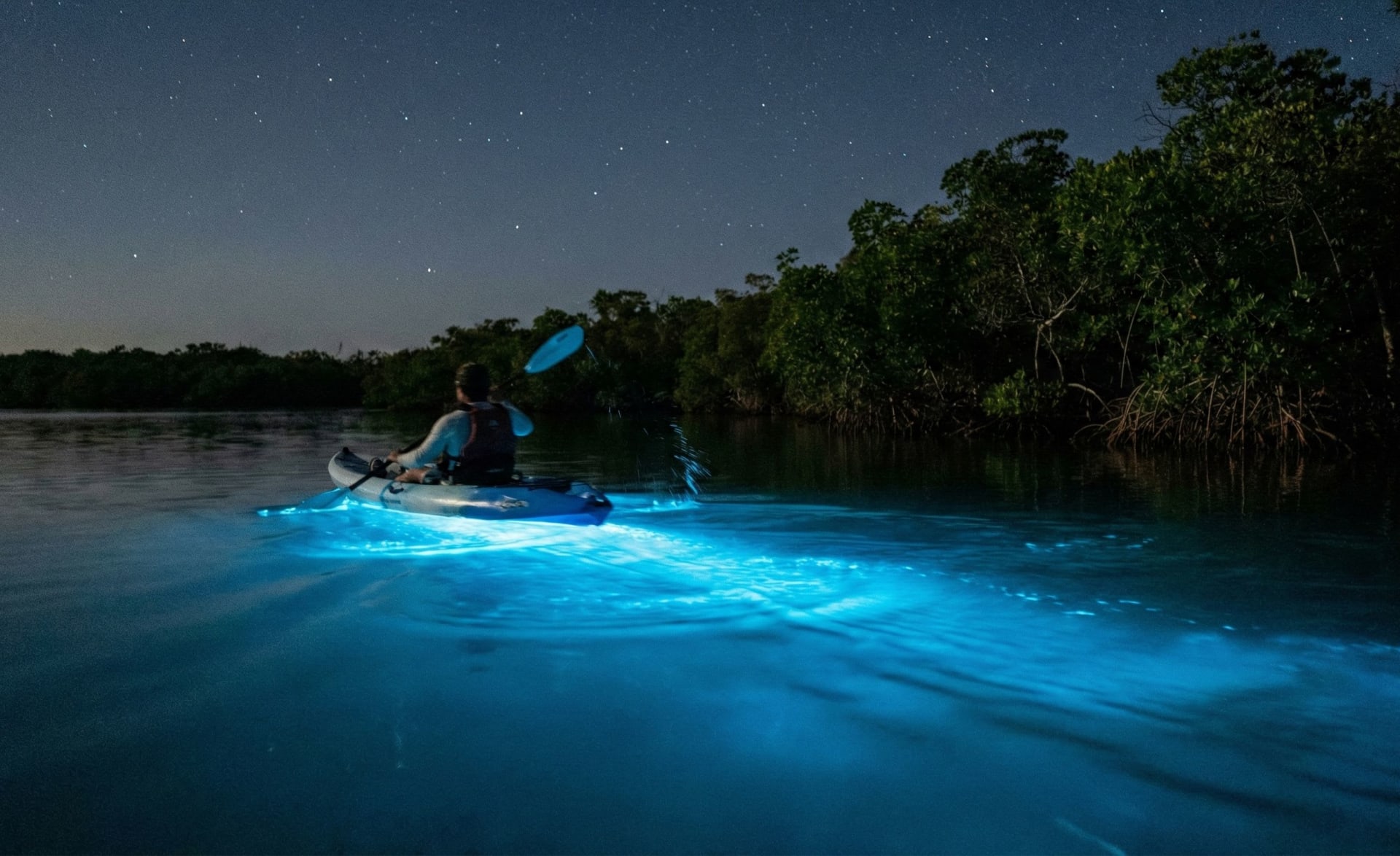
You dip your paddle into the black water of Mosquito Bay and the ocean catches fire. Not orange, not yellow. A cold, electric blue that swirls outward from the blade in ribbons of light, tracing every eddy, every ripple, every drop that falls from the shaft back to the surface. A fish darts beneath your kayak and leaves a streak of neon, like a comet burning through liquid sky. You drag your fingers through the water and each one glows, five blue torches trailing phosphorescence that fades only when the water goes still. Nobody in the kayak behind you is talking anymore. The only sound is the soft plash of paddles and the occasional whispered profanity of someone seeing this for the first time.
This is not a light show. This is a living system, a population of 720,000 or more single-celled organisms per gallon of seawater, each one detonating a chemical flare the instant something touches it. Puerto Rico holds three of the world's five permanent bioluminescent bays. The brightest one, Mosquito Bay on the island of Vieques, holds the Guinness World Record. And on a moonless night, it is one of the most disorienting things a human body can experience.
The Chemistry of Living Light
The organism responsible is Pyrodinium bahamense, a species of dinoflagellate roughly 40 micrometers across. That is about half the width of a human hair. Each cell contains the enzyme luciferase and its substrate, luciferin. When the cell membrane deforms (from a paddle strike, a passing fish, a wave breaking against a mangrove root) the luciferase catalyzes a reaction that oxidizes the luciferin, releasing energy as a brief pulse of blue-green light at approximately 474 nanometers.
One cell firing is invisible to the naked eye. Hundreds of thousands firing simultaneously is not.
The reaction is purely mechanical. No electricity, no heat, no external energy source triggers it. Physical disturbance compresses the cell wall, and the cell responds with light. The evolutionary logic is debated. The leading hypothesis is that the flash startles small predators (copepods, larval fish) long enough for the dinoflagellate to escape. Another theory suggests the light attracts larger predators that eat the things eating the dinoflagellates. Either way, the result for a human observer is that every movement in the water produces light proportional to the force applied. Gentle strokes glow softly. Hard splashes erupt.
What makes Puerto Rico's bays extraordinary is concentration. Open ocean bioluminescence exists worldwide, but it is diffuse, often requiring total darkness and patient eyes. In Mosquito Bay, the dinoflagellate density can exceed 720,000 organisms per gallon, the highest recorded concentration of bioluminescent organisms anywhere on Earth. The reason lies in geography.
Each of these bays shares a specific architecture: a narrow channel connecting to the Caribbean Sea, surrounded by dense red mangrove forest (*Rhizophora mangle*). The mangroves drop leaves into the water constantly. As those leaves decompose, they release tannins, organic acids, and critically, vitamin B12, which *Pyrodinium bahamense* requires for reproduction. The narrow channel restricts water exchange with the open ocean, trapping nutrients and organisms inside. The shallow depth (rarely more than 4 meters) keeps the water warm. The result is a self-sustaining greenhouse for dinoflagellates, a bay-sized bioreactor that has been running for centuries.
When and Where to Go
Puerto Rico has three bioluminescent bays. Each offers a different experience.
Mosquito Bay, Vieques (18.10N, 65.44W) is the brightest and the most famous. It holds the world record and on optimal nights the glow is almost absurd in its intensity. Swimming was banned here in recent years to protect the ecosystem. Kayaking and electric boat tours operate nightly. You reach Vieques by a 30-minute flight from San Juan or a ferry from Ceiba (book the ferry early, it sells out).
Laguna Grande, Fajardo (18.33N, 65.62W) is the most accessible from San Juan, roughly an hour's drive east. Kayak tours launch from the Las Croabas area and paddle through a mangrove channel before entering the lagoon. The concentration is lower than Mosquito Bay but still vivid on dark nights. This is the bay most visitors see first.
La Parguera, Lajas (17.97N, 67.05W) sits on Puerto Rico's southwest coast. It was historically the most visited bay but suffered significant dimming after decades of development and light pollution along the shoreline. Conservation efforts are ongoing. It remains worth visiting, particularly during peak season, but manage expectations. The glow here is subtler.
Outside Puerto Rico, Luminous Lagoon near Falmouth, Jamaica (18.48N, 77.63W) is the most reliable alternative. The organism there is the same genus, and swimming is permitted. Boat tours run nightly.
The single most important variable is moon phase. On a full moon night, even Mosquito Bay can appear underwhelming. Ambient moonlight washes out the bioluminescence the way city lights wash out stars. New moon periods are dramatically better. Plan your visit within five days of a new moon if at all possible. This matters more than season, more than weather, more than which bay you choose.
Peak season runs June through October, when water temperatures are highest and dinoflagellate reproduction accelerates. But the bays glow year-round. A new moon night in January will outperform a full moon night in August every time. Cloud cover actually helps by blocking whatever moonlight exists. Light rain is fine. Heavy storms churn the bay and can temporarily reduce the glow.
Book tours through licensed operators. In Vieques, kayak outfitters depart from the south shore. In Fajardo, multiple companies run from the Las Croabas marina. Group sizes are regulated, and tours fill up during new moon windows. Reserve at least a week ahead during peak season.
How to Witness and Photograph This
Start with an honest expectation: bioluminescence is very dim. Your eyes, once adapted to the dark (give them 15 to 20 minutes away from any screen), will see it vividly. Your phone camera almost certainly will not.
Standard smartphone cameras lack the sensor sensitivity and manual exposure controls needed to capture bioluminescence. If you shoot on auto mode, you will get a black frame or a blurry, noisy mess. Some newer phones with dedicated night modes can pick up a faint glow in video, but the results rarely match what your eyes see.
If documentation matters to you, bring a GoPro or similar action camera with a night mode. Set it to 15 to 30 second exposure at maximum ISO. You cannot use a tripod in a kayak (the movement defeats the purpose), so brace the camera against the hull or your body. Focus on video rather than stills. A 30-second clip of a paddle stroke lighting up the water conveys more than any photograph.
The best subjects: paddle trails pulling sheets of blue behind them, hands swirling water into spirals of light, fish darting beneath the kayak leaving glowing streaks. If your tour guide permits it, cup water in your hands and pour it slowly. Each droplet will flash on impact.
Bring a red-light headlamp or flashlight rather than white light. White light destroys everyone's dark adaptation and kills the experience for fellow paddlers. Red light preserves night vision.
Gear checklist: swimsuit or quick-dry clothing, water shoes (mangrove oysters on the channel walls are razor-sharp), a dry bag for your phone and wallet, waterproof phone case if you want to try underwater shots, towel, bug spray (the mangrove channels breed mosquitoes, and Mosquito Bay earned its name honestly), and a change of clothes for afterward. You will get wet from paddle drip even if you stay in the kayak.
The Fragile Machine
Bioluminescent bays exist in a precise equilibrium. Narrow channel, mangrove canopy, warm shallow water, limited light pollution, minimal chemical runoff. Remove any one variable and the system degrades.
La Parguera is the cautionary example. Decades of coastal development, deforestation of surrounding mangroves, increased boat traffic, and artificial lighting along the shoreline reduced dinoflagellate concentrations from spectacular to modest. The Puerto Rican government has since enacted stricter protections, but recovery is slow.
Mosquito Bay's swimming ban reflects the same concern. Sunscreen, insect repellent, and the sheer mechanical disturbance of hundreds of swimmers per night were stressing the population. Kayaking reduces direct chemical contamination and limits the number of people on the water at any given time.
These bays cannot be manufactured or relocated. The specific combination of mangrove species, channel geometry, water chemistry, and latitude that sustains *Pyrodinium bahamense* at record-breaking densities exists in only a handful of places on Earth. Climate change adds pressure: rising sea temperatures could alter reproduction rates, stronger hurricanes can destroy mangrove forests overnight (Hurricane Maria in 2017 temporarily dimmed Mosquito Bay), and sea level rise threatens to widen the channels that keep nutrients trapped.
What makes the bioluminescent bays remarkable is not just the light itself. It is the reminder that the most astonishing displays on this planet often depend on the most delicate systems. A single-celled organism, smaller than a grain of pollen, converting mechanical energy into photons through a 3-billion-year-old chemical reaction, visible only because a mangrove forest drops its leaves into a sheltered cove at the right latitude. Everything connected. Everything contingent.
On a dark night in Mosquito Bay, when you lift your paddle and watch the blue fire drip back into the black water, that connection is not abstract. It is immediate, physical, and glowing in your hands.
This is the short version
This page shows a taste. The app has the full list of where to see this, the exact timing, and live conditions for 1,000+ natural phenomena worldwide, so you know the moment one is genuinely worth the trip.