As of Jun 17, 2026, 4:21 PM, peak season now, through ~August 31. Earth Exhibit tracks the live conditions and flags it the moment it is on.
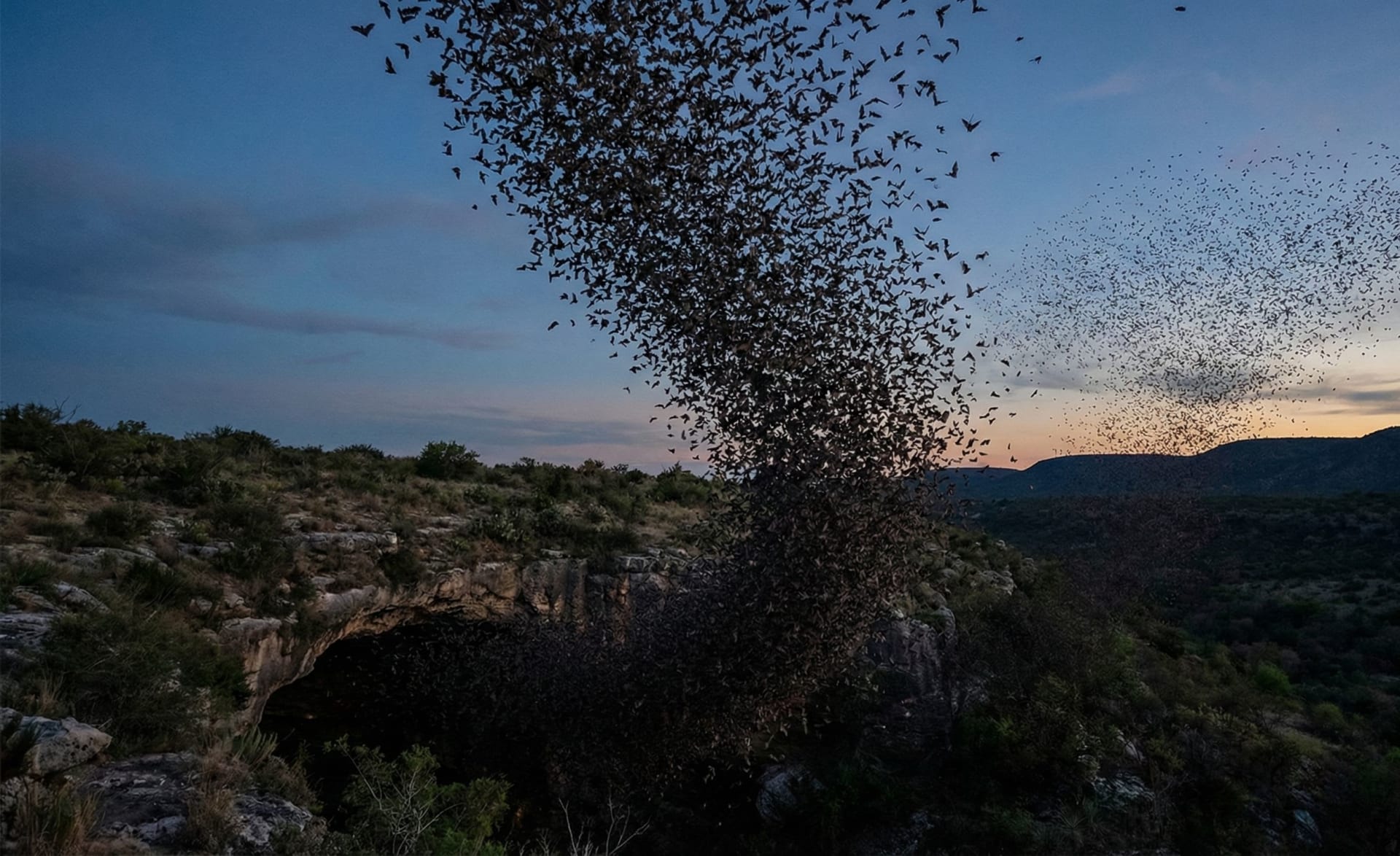
The first thing you notice is the sound. Not the bats themselves, not yet. It is the silence that falls over the crowd of maybe forty people standing at the rim of a sinkhole in the Texas Hill Country, fifteen miles northeast of San Antonio. Someone whispers. A child tugs a sleeve. Then a low chittering rises from underground, a frequency you feel in your sternum before your ears fully register it. A dark smudge lifts from the cave mouth. Then another. Then the smudge becomes a river, a spiraling counterclockwise vortex of wings, and within minutes you cannot see the sunset through the column of 15 to 20 million Mexican free-tailed bats (Tadarida brasiliensis) pouring into the sky. The emergence at Bracken Cave is not a spectacle you watch. It is a spectacle that swallows you.
The Science Behind the Spiral
Bracken Cave Preserve, owned and managed by Bat Conservation International (BCI), sits at 29.69N, 98.35W in Comal County, Texas. The limestone sinkhole entrance opens into a cavern system that has sheltered bats for an estimated 10,000 years. Today it hosts the largest bat colony on Earth.
The colony is a maternity colony. Female Mexican free-tailed bats arrive pregnant in March after migrating north from central Mexico. They give birth between June and July, each mother producing a single pup. For the first few weeks, pups cling to the cave ceiling while mothers leave nightly to feed. By August, juveniles join the evening emergence, swelling the already staggering numbers.
The nightly emergence begins at dusk and can last three to four hours as the colony empties in waves. Bats spiral out in a tight counterclockwise vortex, a pattern thought to reduce collisions and create aerodynamic lift for individuals drafting in the column. Once clear of the cave, they disperse across the landscape in ribbons that stretch for miles, visible on weather radar as a characteristic "bloom" expanding from a single point. National Weather Service offices in San Antonio routinely note the signature and have occasionally had to explain to concerned callers that no, a storm is not forming over Comal County. Those are bats.
The speed of Tadarida brasiliensis in level flight can reach 160 km/h (99 mph), making it one of the fastest horizontal fliers in the animal kingdom. They climb to altitudes of 3,000 meters (nearly 10,000 feet), feeding on moths, beetles, and other insects drawn to those altitudes by thermals and wind currents. The colony's collective appetite is extraordinary: researchers estimate the Bracken Cave bats consume 100 to 200 tons of insects per night, with a particular appetite for corn earworm moths (Helicoverpa zea), a devastating agricultural pest. Studies from the University of Tennessee have valued the pest-control services of Mexican free-tailed bats in the south-central United States at billions of dollars annually. Every bat spiraling out of that cave mouth is an unpaid farmhand.
Predators know the schedule. Red-tailed hawks and Cooper's hawks station themselves near the entrance at dusk. Occasionally a rat snake or coachwhip will position itself on the rock face. The bats counter with sheer numbers. When 20 million animals leave a building, losing a few dozen to predators is statistically insignificant.
When and Where to Witness It
Peak season runs from June through August, when the maternity colony is at full strength and pups begin flying. Emergences occur from March through October, but early and late season populations are smaller and weather dependent. The bats depart for Mexico by November.
Bracken Cave Preserve is not a public park. Access is limited to BCI members and invited guests. BCI offers member nights throughout the summer, typically on select evenings from May through October. Annual membership starts at $35, and member nights require advance registration, which fills quickly. If you plan to attend, join BCI by early spring and watch their event calendar. Capacity is capped to protect the colony, so procrastination is punished.
For those who cannot get to Bracken Cave, several alternatives offer their own remarkable emergences:
Congress Avenue Bridge, Austin (30.26N, 97.74W). The largest urban bat colony in North America roosts beneath this bridge over Lady Bird Lake. Approximately 1.5 million Mexican free-tailed bats emerge at dusk from March through November. The viewing is free, public, and frankly one of the best wildlife experiences available in any American city. The south bank of the lake offers the best sightlines. Kayak outfitters run "bat watching" paddles that put you directly beneath the emergence.
Carlsbad Caverns National Park, New Mexico (32.14N, 104.54W). The bat flight amphitheater at the natural entrance seats hundreds of visitors who gather for ranger-led programs before the emergence. The colony here is smaller (estimates vary between 200,000 and 500,000) but the setting, a desert canyon at sunset, is superb.
Frio Bat Flight Tours, Concan, Texas (29.45N, 99.66W). A privately operated viewing site near the Frio River where a colony of roughly 10 million bats emerges from a series of caves. Tours run nightly during summer months and include guided commentary.
At all sites, arrive at least 30 to 45 minutes before sunset. The exact emergence time shifts with daylight length and weather. Overcast skies or approaching storms can delay or suppress the flight. Hot, clear evenings with low wind produce the most dramatic emergences.
Photography and Witnessing Guide
One rule supersedes all others: no flash photography. Ever. Flash disturbs roosting bats and, in extreme cases, can trigger roost abandonment, where millions of bats leave a site permanently. At Bracken Cave, BCI enforces this strictly. At Congress Avenue Bridge, there is no enforcement, which means you will see tourists firing flash into the colony. Do not be one of them. Disable your flash before you arrive. If your phone does not let you disable flash easily, put it away and use your eyes.
Camera settings for bat emergence photography:
- ISO 3200 to 6400 or higher. You are shooting in rapidly fading light. Noise is acceptable. A blurry image from a slow shutter speed is not.
- Aperture f/2.8 or wider. A fast prime lens (35mm or 50mm f/1.8) outperforms a slow zoom here.
- Shutter speed 1/500 or faster. Bats in flight are quick and erratic. Anything slower produces smears unless you are intentionally going for motion blur.
- The classic shot is silhouettes against the sunset sky. Position yourself so the emergence column passes between you and the western horizon. The bats become dark calligraphy against gradients of orange and purple.
- Video captures the phenomenon better than stills. The swirling, pulsing motion of the vortex is what makes the emergence extraordinary. A single frozen frame, no matter how well composed, loses the kinetic energy. Shoot both, but if you must choose, choose video.
- At Congress Avenue Bridge specifically, shoot from the south bank with the bridge as foreground. The bats emerge from beneath the bridge and stream eastward along the lake, giving you a layered composition of water, bridge, and bat column.
What to bring: A lawn chair or blanket (you will be waiting), insect repellent (the irony of needing bug spray at a bat viewing is not lost on anyone), a light jacket for the evening cool, binoculars if you want to pick out individual flight patterns, and patience. The emergence does not start on a schedule. It starts when the bats decide.
What to leave behind: Expectations of a quick show. At Bracken Cave, the full emergence can last over three hours. The first ten minutes are riveting. The next twenty are mesmerizing. Somewhere around the forty-minute mark, your brain recalibrates and you realize you have been standing with your mouth open, watching an unbroken river of wings, and there is no end in sight. That recalibration is the real experience.
The Bigger Picture
Mexican free-tailed bats face a complicated future. White-nose syndrome, the fungal disease (Pseudogymnoascus destructans) that has killed millions of hibernating bats in eastern North America, has been detected in Texas. Tadarida brasiliensis does not hibernate in the traditional sense (it enters torpor but remains semi-active), which may offer some protection, but researchers are monitoring closely. Wind energy development across the migratory corridor between Mexico and Texas poses a growing collision risk. Habitat loss around maternity caves threatens the buffer zones that protect colonies from disturbance.
Bracken Cave itself narrowly avoided disaster in 2014 when a proposed housing development of 3,500 homes was planned for land adjacent to the preserve. BCI, with support from donors and the city of San Antonio, purchased the 1,521-acre tract to create a permanent buffer. The colony survived because people decided it mattered. That decision was not sentimental. It was economic. The pest-control value of those 20 million bats to Texas agriculture dwarfs the cost of the land purchase.
The emergence at Bracken Cave is the largest concentration of mammals on Earth, assembling and dispersing on a nightly basis with no human intervention, no infrastructure, and no admission fee (BCI membership notwithstanding). It has been happening for ten millennia. It will keep happening as long as the cave stands and the insects fly and the corridor between Mexico and Texas remains passable. Witnessing it is about standing at the edge of a hole in the ground and understanding, viscerally, that the world contains events of a scale your imagination cannot manufacture on its own. You have to be there. You have to hear the chittering climb. You have to watch the sky fill.
This is the short version
This page shows a taste. The app has the full list of where to see this, the exact timing, and live conditions for 1,000+ natural phenomena worldwide, so you know the moment one is genuinely worth the trip.