As of Jun 17, 2026, 4:21 PM, out of season, returns ~September. Earth Exhibit tracks the live conditions and flags it the moment it is on.
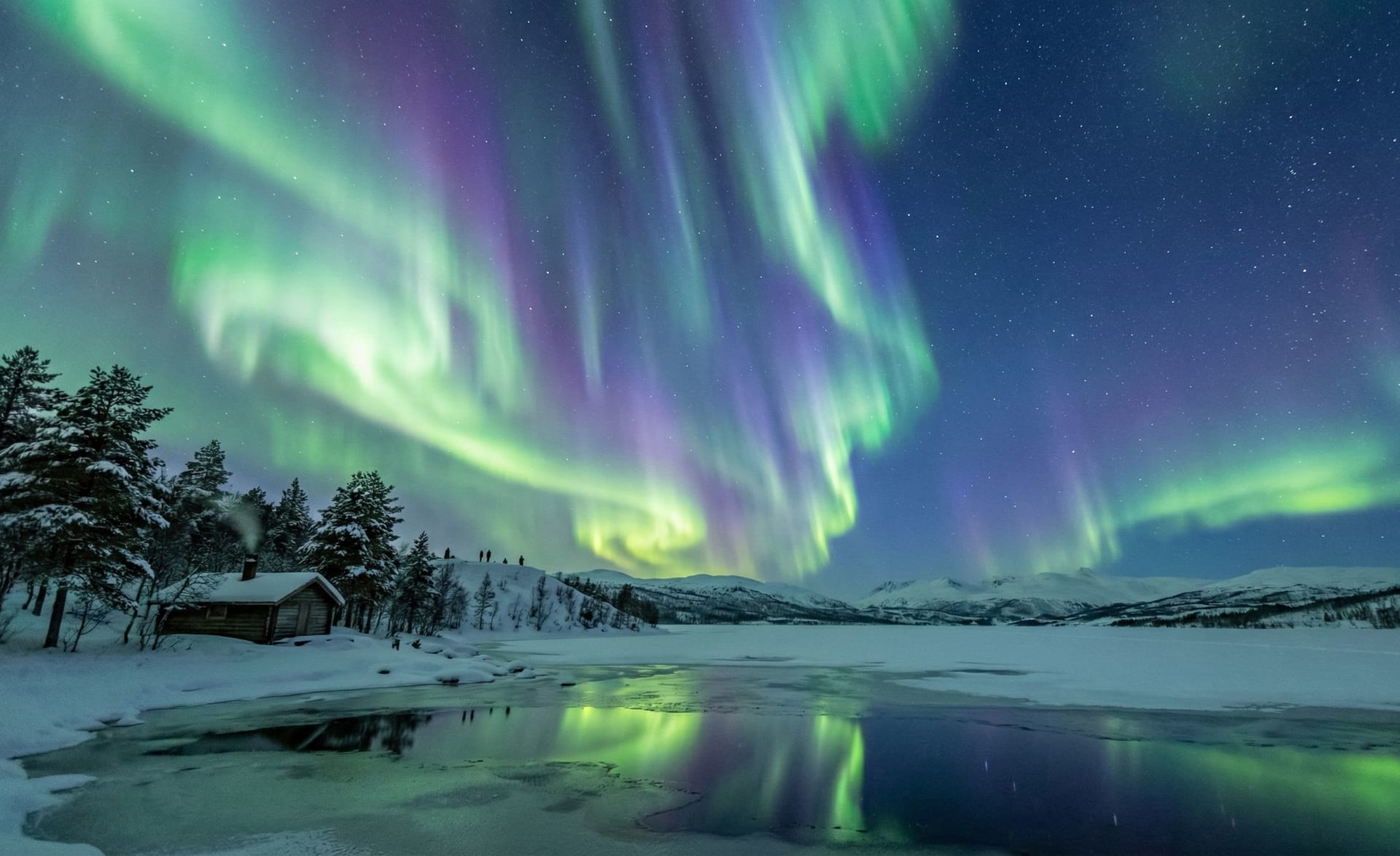
The first time you see it, your brain doesn't believe your eyes. You're standing on a frozen lake outside Abisko, Sweden, at 68.3 degrees N, and the temperature reads minus 22 degrees Celsius. Your tripod legs creak when you extend them. Your breath crystallizes mid-air and drifts sideways in a faint wind. Then, above the treeline, a pale greenish smear appears. You think it might be a cloud. It isn't. Within four minutes, the smear stretches into a ribbon that spans 40 degrees of sky, and then it starts to move. Curtains of green light roll overhead like fabric caught in a draft, and you can hear your own pulse because nobody around you is saying a word.
That green light has traveled 150 million kilometers to reach your retinas. It started on the surface of the sun.
What Fires the Sky: Solar Wind Meets Atmosphere
The aurora borealis begins with the sun ejecting charged particles (mostly electrons and protons) at speeds between 400 and 800 kilometers per second. This solar wind streams outward in all directions, and when it reaches Earth roughly two to four days later, it collides with the magnetosphere, the magnetic bubble generated by our planet's molten iron core.
Earth's magnetic field funnels those charged particles toward the polar regions along invisible field lines. When the particles plunge into the upper atmosphere at altitudes between 100 and 300 kilometers, they slam into gas molecules. The collisions excite orbital electrons in those molecules, bumping them to higher energy states. When the electrons drop back down, they release photons. That's the light you see.
The color depends entirely on which gas gets hit and at what altitude. Oxygen atoms at around 100 to 200 kilometers produce the dominant green glow at 557.7 nanometers, the wavelength most commonly photographed. Higher up, between 200 and 300 kilometers, oxygen emits a deep red at 630 nanometers, a color that often crowns the green curtains during strong storms. Nitrogen molecules contribute blue and purple hues, typically visible at the lower edges of the display where particle energy is highest.
Scientists measure geomagnetic activity using the Kp index, a scale from 0 to 9. A Kp of 3 or higher generally means visible aurora at high latitudes. At Kp 5, displays push south enough to reach places like Edinburgh, Scotland (55.9 degrees N). During exceptional storms (Kp 7 to 9), aurora has been documented as far south as 40 degrees N, putting cities like Denver, Madrid, and Beijing under faint red glows. The Carrington Event of September 1859, the most powerful geomagnetic storm on record, produced aurora visible from Colombia and Hawaii.
Coronal mass ejections (CMEs), massive eruptions of solar plasma, drive the strongest displays. A single CME can carry a billion tons of magnetized plasma and compress Earth's magnetosphere dramatically upon impact. NOAA's Space Weather Prediction Center issues watches and warnings for incoming CMEs, typically providing 15 to 45 minutes of lead time once a disturbance is detected by the DSCOVR satellite at the L1 Lagrange point, 1.5 million kilometers sunward.
When and Where to Stand
The aurora season runs from September through April, with the core months of October through February offering the longest dark skies at high latitudes. Summer months at 64 degrees N and above bring near-perpetual twilight, washing out all but the most violent displays.
Five locations consistently deliver:
Tromso, Norway (69.6 degrees N) sits directly under the auroral oval, the ring of peak geomagnetic activity centered on the magnetic north pole. The city offers easy access, a mild coastal climate for its latitude (January averages hover near minus 4 degrees Celsius thanks to the Gulf Stream), and surrounding fjords that provide dark-sky foregrounds within a 30-minute drive.
Fairbanks, Alaska (64.8 degrees N) benefits from a continental interior climate with frequent clear skies. The Geophysical Institute at the University of Alaska Fairbanks operates one of the world's most reliable aurora forecast systems, updated every few minutes. Chena Hot Springs Road east of town is a classic viewing corridor, far from city light pollution.
Yellowknife, Canada (62.5 degrees N) sits beneath the auroral oval and records some of the highest clear-sky rates of any aurora destination. The flat terrain of Great Slave Lake provides unobstructed 360-degree horizons. Local outfitters run heated viewing cabins on the frozen lake from November through March.
Reykjavik, Iceland (64.1 degrees N) offers aurora within a short drive of the city center, particularly toward the Reykjanes or Thingvellir areas. Cloud cover is the primary obstacle here. Checking the Icelandic Met Office cloud forecast matters as much as checking Kp values.
Abisko, Sweden (68.3 degrees N) holds a reputation among aurora photographers as one of the most reliable spots in Scandinavia. The "blue hole of Abisko," a microclimate phenomenon caused by Lake Tornetrask, creates a pocket of clearer skies compared to surrounding regions. The Aurora Sky Station at 900 meters elevation sits above the low cloud layer that often blankets the valley floor.
Timing within a given night matters, too. Geomagnetic activity typically peaks between 10 PM and 2 AM local magnetic time, though substorms can fire at any hour. Displays often arrive in waves: a quiet arc low on the northern horizon will suddenly brighten, break into bands, and pulse overhead for 20 to 40 minutes before fading, only to reignite an hour later.
Capturing and Witnessing the Display
Before you touch a camera, watch with your eyes for ten minutes. Cameras with long exposures will reveal colors your dark-adapted eyes perceive as faint gray or white. The human eye needs a Kp 4 or higher display before greens become vivid to unaided vision.
That said, photography settings are straightforward once you know the formula.
Use a sturdy tripod. There is no substitute. Handheld aurora shots do not work. Plant the tripod on packed snow or ice, and hang your pack from the center column if wind is a factor.
Shoot in manual mode. Set your lens to its widest aperture, ideally f/2.8 or wider. A 14-24mm wide-angle lens captures the full sweep of curtains. Set ISO between 1,600 and 6,400 depending on the display's brightness. Start at ISO 3,200 and adjust. Shutter speed falls between 5 and 25 seconds: shorter for fast-moving corona displays (to avoid blur), longer for faint, slow arcs.
Focus manually. Autofocus will hunt and fail in the dark. Switch your lens to manual focus, aim at a bright star or distant light, and use live view at maximum zoom to nail critical focus. Some photographers set focus, then tape the focus ring in place with gaffer tape.
Disable image stabilization when shooting on a tripod. The IS system can introduce micro-vibrations during long exposures, softening the image.
Shoot in RAW format. Aurora colors are subtle gradients that degrade under JPEG compression. RAW files preserve the full tonal range for post-processing.
Include foreground. A sky-only aurora shot lacks scale and context. Trees, cabins, frozen lakes, mountain ridgelines, or even a silhouetted figure will anchor the image and give viewers a sense of place.
Keep multiple batteries inside your jacket pockets, rotating them into the camera as each one drains. Lithium-ion cells lose capacity rapidly below minus 10 degrees Celsius. A fully charged battery that lasts 400 frames at room temperature might deliver 80 frames at minus 25 degrees Celsius.
A red headlamp preserves your night vision while you adjust settings. White light will reset your dark adaptation, requiring another 20 minutes to recover full sensitivity.
Bring a thermos of something hot. You'll be standing still for hours. Insulated boots, a balaclava, hand warmers inside your gloves, and toe warmers inside your boots are not optional at these latitudes. Frostbite at minus 20 degrees Celsius can begin on exposed skin within 30 minutes.
The Larger Pattern
The aurora borealis operates on an 11-year solar cycle. Solar maximum, the period of peak sunspot and CME activity, produces the most frequent and intense displays. Solar Cycle 25 began in December 2019, and current NOAA forecasts place its maximum in the 2024 to 2026 window, meaning the next two years may offer some of the strongest aurora seasons in over a decade.
But the aurora is also a reminder that Earth exists inside a star's atmosphere. The same solar wind that paints the polar sky green can, during extreme events, induce ground currents that overload power grids. The March 1989 geomagnetic storm knocked out Hydro-Quebec's power system for nine hours, leaving six million people in the dark. Understanding space weather is not purely aesthetic.
The northern lights have a southern counterpart, the aurora australis, visible from Antarctica, southern New Zealand, and Tasmania. The two auroras are near-mirror images, generated simultaneously by the same solar wind event hitting both magnetic poles. Satellite imagery during major storms shows twin glowing ovals, one crowning each pole, connected by the invisible architecture of Earth's magnetic field.
Every photon of aurora light represents a collision that happened 100 kilometers above your head roughly one second ago. You are watching the atmosphere fluoresce in real time, a process powered by a star 150 million kilometers away, filtered through a magnetic field generated by liquid iron churning 3,000 kilometers beneath your feet. The scale of the machinery behind that green curtain is worth sitting in the cold for.
This is the short version
This page shows a taste. The app has the full list of where to see this, the exact timing, and live conditions for 1,000+ natural phenomena worldwide, so you know the moment one is genuinely worth the trip.