As of Jun 17, 2026, 4:21 PM, peak season now, through ~July 20. There is recent confirmation nearby. Earth Exhibit tracks the live conditions and flags it the moment it is on.
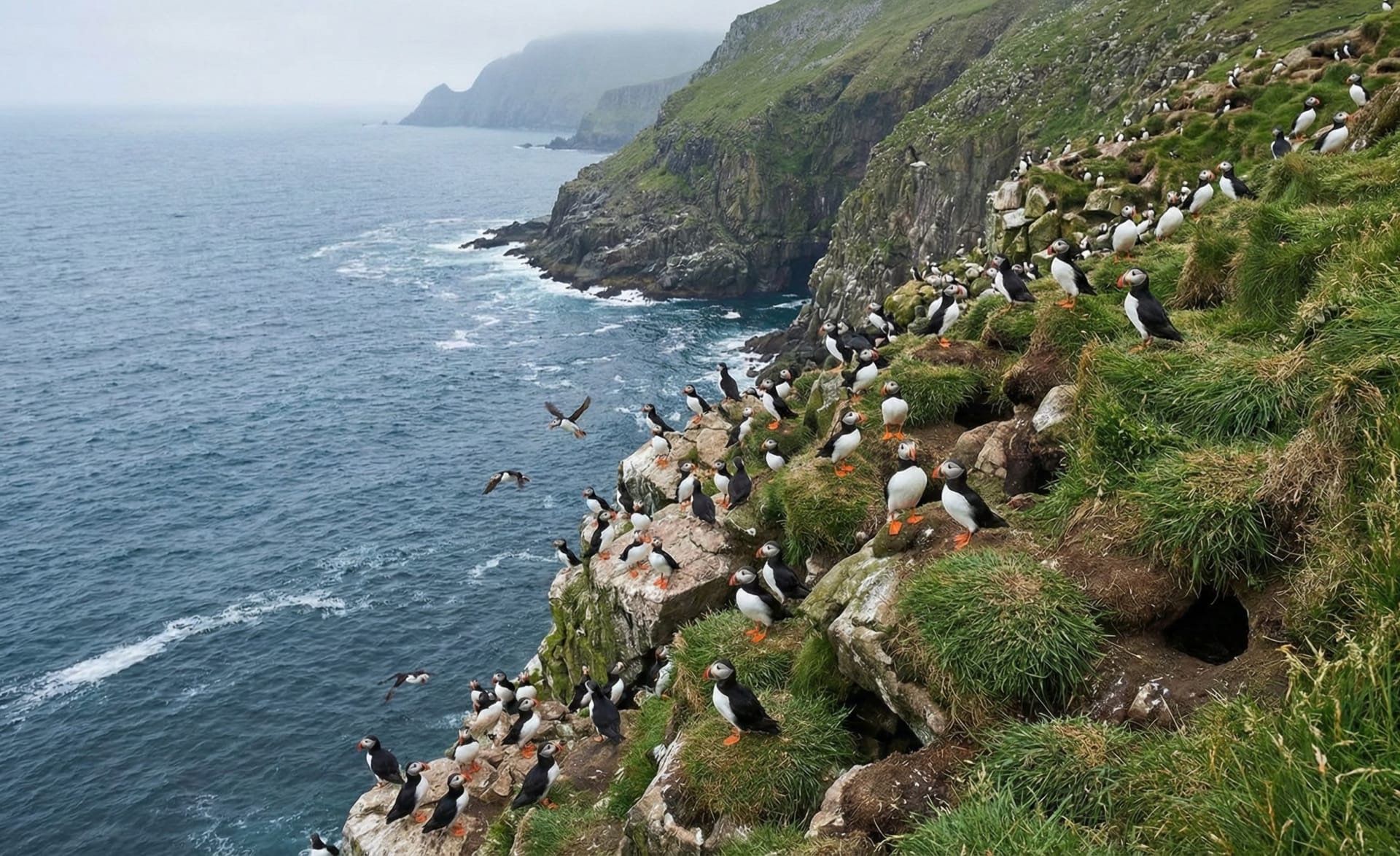
The wind at Latrabjarg hits you before the birds do. It comes straight off the Denmark Strait, forty knots of cold Atlantic air that makes your eyes water and flattens the grass against the clifftop. You crawl to the edge on your stomach, peer over, and the entire vertical face of the cliff is alive. Thousands of puffins, packed into burrows and ledges from the waterline to just below your elbows, turning their heads to study you with the same idle curiosity you are directing at them. One sits close enough to touch, a beak stuffed with a fan of silver sand eels, blinking its orange-ringed eye. It does not fly. It just looks at you. Then it waddles into its burrow, and six more land on the ledge behind it, and you realize you are lying at the rim of the largest seabird cliff in Europe, 14 kilometers of vertical rock holding roughly one million nesting pairs of Fratercula arctica.
The Atlantic puffin colonies open in April and close by mid-August. Right now, they are coming back.
The Biology of a Cliff City
The Atlantic puffin (Fratercula arctica, meaning "little brother of the Arctic") is a pelagic seabird that spends eight to nine months of the year at sea, ranging across the open North Atlantic from Newfoundland to northern Norway. It is built for ocean life. Dense, waterproof plumage. Wings adapted for underwater propulsion that let it chase sand eels and sprat to depths of 60 meters. A specialized salt gland above each eye that excretes excess sodium, allowing it to drink seawater indefinitely.
But puffins cannot breed at sea. Every spring, roughly 12 million adults return to land, converging on a handful of coastal cliff colonies to dig burrows, pair off, and raise a single chick. The breeding season is compressed and urgent. Puffins are monogamous across seasons, returning to the same burrow with the same partner year after year. Pairs that lose their burrow to a collapsed tunnel or an aggressive neighbor may skip breeding entirely rather than settle for an inferior site.
The famous beak deserves its reputation, but not for the reason most people assume. That vivid orange-and-blue striping is temporary. It is a keratinous sheath that grows over the smaller, duller winter bill specifically for the breeding season. The bright plates serve as visual signals during courtship, and UV-reflective patterns on the beak (invisible to the human eye but vivid to other puffins) help individuals assess each other's fitness. After breeding ends in August, the colorful plates shed, and the beak returns to a muted grey-brown. The bird you see on the cliffs in June and the bird floating in the mid-Atlantic in December look like two different species.
Nesting happens underground. Puffins dig burrows up to 1.5 meters deep into clifftop soil, using their beaks to loosen earth and their feet (equipped with sharp claws) to kick it clear. A good burrow is a valuable commodity. Some have been reused for decades. The female lays a single egg, and both parents share incubation duties over approximately 36 to 45 days. Once the chick hatches, the provisioning runs begin. A puffin can carry an average of 10 fish per trip, held crosswise in its serrated beak while flying back from foraging grounds up to 50 kilometers offshore. The record documented count is 62 fish in a single beakload, though anything above 20 is unusual.
The chick, called a puffling, grows rapidly in the dark burrow for about six weeks. Then, alone, at night, it walks to the cliff edge and launches itself into the Atlantic. It will not return to land for two to three years.
When and Where to See Them
The colonies are active from April through August, with peak numbers and peak activity falling between mid-May and mid-July. Timing varies by latitude, with Icelandic colonies peaking slightly later than British ones.
Latrabjarg, Iceland (65.5N, 24.5W) is the westernmost point in Europe and the single most accessible large puffin colony on Earth. The cliffs stretch 14 kilometers and rise 441 meters at their highest. No fences, no barriers, no admission fee. You can lie flat on the clifftop and watch puffins at arm's length. Peak season runs late May through early August. The catch: it is a five-hour drive from Reykjavik on Route 612, much of it unpaved. There is no public transport. Rent a car and budget a full day for the drive each way, or stay in the village of Breidavik.
Storhofdi, Heimaey, Vestmannaeyjar, Iceland (63.4N, 20.3W) sits on the southern tip of Heimaey Island in the Westman Islands archipelago. The Westman Islands hold the largest Atlantic puffin colony in the world, an estimated four million individuals breeding across the island group. Storhofdi is one of the windiest places in Iceland (gusts regularly exceed 100 km/h), and also one of the best puffin viewpoints. Access is by ferry from Landeyjahofn on the south coast (about 35 minutes) or a short domestic flight from Reykjavik.
Farne Islands, UK (55.6N, 1.6W) are a cluster of rocky islets off the Northumberland coast, managed by the National Trust. Boat tours depart from Seahouses, and landings on Inner Farne and Staple Island put you among nesting puffins, Arctic terns (which will dive-bomb you), razorbills, and guillemots. Approximately 44,000 puffin pairs nest here. The season runs May through July, with mid-June being the sweet spot for chick-feeding activity. Boat tours book up quickly; reserve several weeks ahead. Landing fees apply.
Skellig Michael, Ireland (51.8N, 10.5W) is a UNESCO World Heritage site 12 kilometers off the Kerry coast. The boat crossing is rough. Landings get cancelled regularly due to Atlantic swells, and even on a "good" day, the transfer from boat to rock landing involves timing your jump with the surge. If you get on, you share the island with sixth-century monastic ruins and a healthy puffin colony on the grassy slopes above the landing. The experience is extraordinary, but plan for the real possibility that weather cancels your trip. Season runs mid-May through August, with boat operators running from Portmagee and Ballinskelligs.
Runde Island, Norway (62.4N, 5.6E) holds Norway's largest seabird colony, with around 100,000 puffin pairs along its western cliffs. Connected to the mainland by a bridge, Runde is far more accessible than most island colonies. A marked hiking trail leads to the main viewpoints above the nesting cliffs. Peak season is May through July.
Photographing and Witnessing Puffin Colonies
Latrabjarg changes the rules of wildlife photography. At most colonies, you need a telephoto in the 200 to 400mm range to get frame-filling puffin shots. At Latrabjarg, a 70-200mm is often too long. The birds sit less than two meters from the cliff edge, and they are remarkably unbothered by quiet, prone observers. Bring a wider lens than you think you need.
For every other colony, 200 to 400mm is the working range. A 100-400mm zoom gives you flexibility for both perched portraits and flight shots. Puffins returning with fish make the classic image: bird in flight, beak crammed with sand eels, orange feet splayed for landing. Catch them against a clean sky or dark cliff background for separation.
Morning light works best for most cliff colonies, as many face east or southeast. The low sun warms the orange of the beak and feet while throwing the cliff face into textured relief. Overcast days, and you will get plenty of them in Iceland and Scotland, actually help with puffin photography. The white chest feathers blow out easily in direct sun, and cloud cover eliminates harsh shadows that hide the facial detail.
Puffins are curious. Sit still near a burrow entrance and they will often approach, cocking their heads to examine you. Do not chase this. Let them come to you. The best behavioral shots (billing, fish delivery, squabbles between neighbors) happen when the birds forget you are there, which takes about ten minutes of stillness.
Gear beyond the camera matters. Rain gear is essential everywhere these birds live. Waterproof over-trousers, a wind-resistant shell, warm mid-layers even in June. Clifftop winds at Latrabjarg and Storhofdi can knock you sideways. Hiking boots with ankle support for the trail to any viewpoint. Binoculars for scanning the water and distant ledges. If you are taking a boat to the Farnes or Skellig Michael, pack seasickness medication and take it before boarding, not after the nausea starts. The crossings are short but can be violent in any kind of swell.
One practical warning: at the Farne Islands, Arctic terns nest alongside puffins and they will attack your head. Wear a hat. Some visitors carry a stick held above their head, which the terns strike instead of your scalp. This is not a joke. Blood has been drawn.
The Bigger Picture
The Atlantic puffin is classified as Vulnerable on the IUCN Red List, a status it received in 2015 after sustained population declines across much of its range. Iceland holds roughly 60% of the global breeding population, and Icelandic colonies have declined by an estimated 35% since 2003. The Vestmannaeyjar colony, once the largest in the world with over four million pairs, has seen repeated breeding failures in the past two decades.
The primary driver is food availability. Sand eels (Ammodytes marinus) and juvenile herring form the core of puffin chick diets, and warming sea surface temperatures in the North Atlantic have shifted these prey species northward and deeper, beyond the diving range of provisioning adults. In poor food years, puffin chicks starve in the burrow. Entire colonies can produce zero fledglings.
The Westman Islands have a tradition that captures this tension. Each August, newly fledged pufflings leave their burrows at night, orienting toward the open ocean by the light of the moon. Town lights confuse them. Hundreds of young birds crash-land in the streets of Heimaey each season, disoriented and grounded. Local children go out with flashlights and cardboard boxes, collecting the pufflings and releasing them from the harbor the next morning. The tradition, called puffling patrol, has been running for decades and saves thousands of birds per year. It also means that each August, the children of Heimaey hold in their hands, literally, the future of a species whose survival is no longer guaranteed.
Norway's colonies tell a similar story. Runde Island's puffin population has dropped from over 200,000 pairs in the 1980s to roughly 100,000 today. Norwegian researchers tracking adult survival rates have documented that the decline correlates tightly with North Sea sand eel stocks. When the fish are present, the puffins breed successfully. When they are not, the colony contracts.
These birds are not on the edge of extinction. Millions still breed across the North Atlantic. But the trajectory is pointed in one direction, and the window to witness a colony at full density is not something to take for granted over the next decades.
This is the short version
This page shows a taste. The app has the full list of where to see this, the exact timing, and live conditions for 1,000+ natural phenomena worldwide, so you know the moment one is genuinely worth the trip.