As of today, out of season, returns ~August. Earth Exhibit tracks the live conditions and flags it the moment it is on.
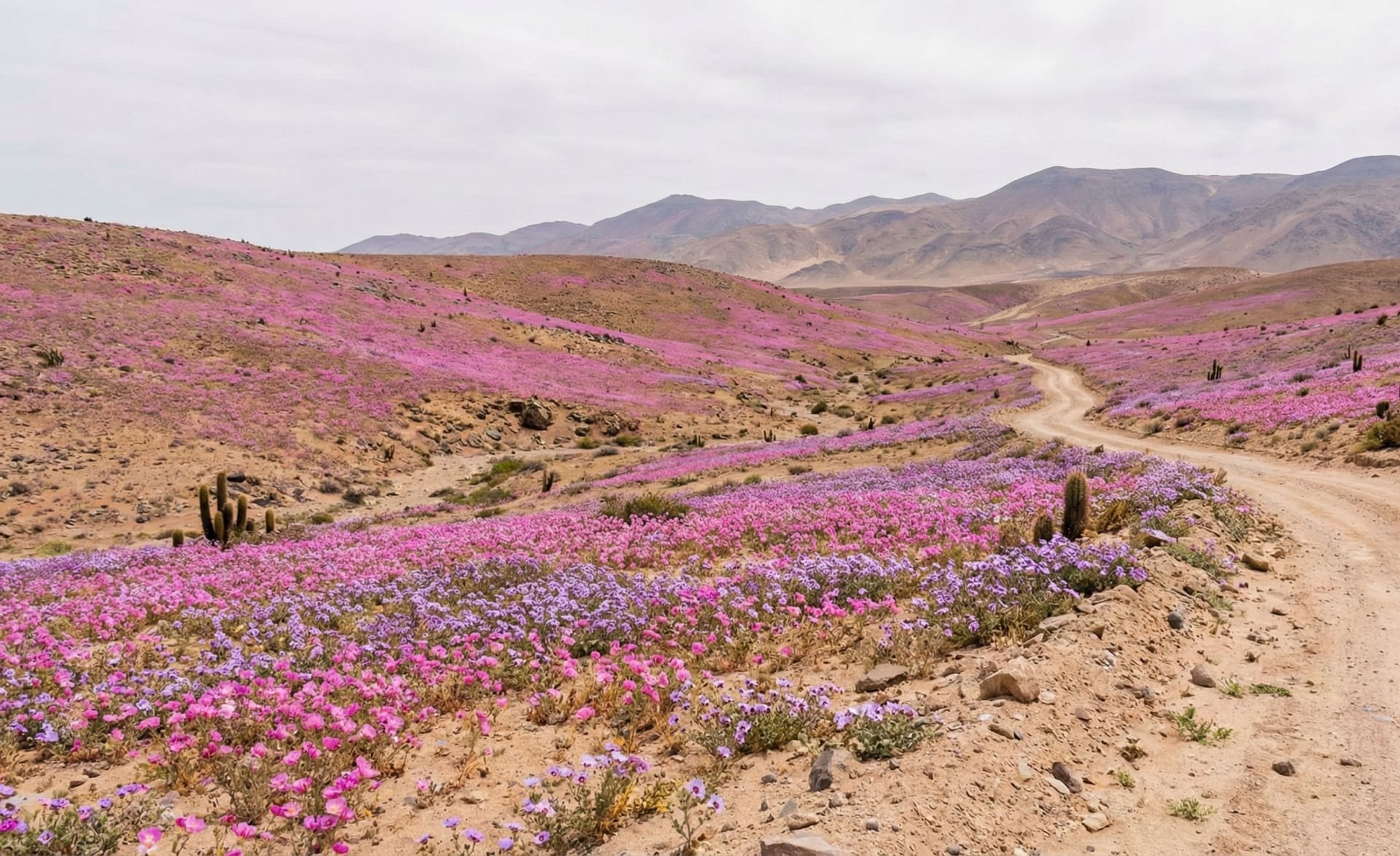
You smell it before you see it. Standing on a gravel shoulder along Ruta 5, somewhere south of Copiapo, the wind carries something that doesn't belong here: pollen. The Atacama is supposed to be the color of rust and bone, a place where rain gauges sit empty for years. But today the valley floor is a disorienting wash of fuchsia, violet, and sulfur yellow stretching to the base of mountains that have never looked so small. Over 200 species of flowering plants are erupting from soil that, six months ago, appeared completely dead. The ground crunches under your boots, and between the gravel, tiny green rosettes are still pushing through, days away from opening. The desert is not done yet.
This is the desierto florido, the Atacama Flowering Desert, and it is one of the most dramatic botanical events on the planet.
The Science of Seeds That Wait Decades
The Atacama Desert stretches roughly 1,000 kilometers along Chile's northern coast, pinched between the Andes and the Pacific. In a typical year, weather stations near Copiapo (-27.37, -70.33) record less than 15 millimeters of rainfall. Some interior stations have logged years with no measurable precipitation at all. By most biological standards, this is not a place where anything should grow.
But buried in the top few centimeters of soil lies a seed bank of extraordinary patience. Seeds from species like Rhodophiala rhodolirion (the Chilean amaryllis), Cistanthe grandiflora (pata de guanaco), and the iconic Leontochir ovallei (Garra de Leon, or lion's claw) can remain dormant for decades, their embryos locked inside hard coats that resist desiccation, UV radiation, and temperature swings that push past 40 degrees Celsius on summer afternoons.
The trigger is rain, and not just any rain. The desierto florido requires 15 to 30 millimeters above normal rainfall, usually delivered by frontal systems strengthened during El Nino years. When the Pacific's equatorial waters warm, storm tracks shift southward, and moisture that would normally bypass the Atacama gets funneled into its coastal valleys. The rain soaks into sandy soils, softening seed coats through a process called imbibition. Hormonal inhibitors wash away. Within days, radicles push downward and cotyledons crack the surface.
What follows is a botanical arms race. These plants evolved to complete their entire reproductive cycle (germination, growth, flowering, pollination, seed set) in a compressed window of six to ten weeks. There is no second chance. Pollinators, many of them specialist bees and flies that have their own dormancy strategies, emerge in synchrony. The result is a feedback loop: mass flowering attracts mass pollination, which produces mass seed, which reloads the soil bank for the next event.
Major blooms occur roughly every five to seven years, though minor flowering events can happen more frequently in localized pockets. The most spectacular recorded events in recent decades occurred in 2015 and 2017 (back-to-back, a rarity attributed to consecutive El Nino conditions). During the 2015 event, satellite imagery from NASA's Terra satellite showed green and pink patches visible from orbit across a region that normally registers as uniform tan.
The phenomenon is not limited to herbaceous annuals. Perennial geophytes (bulb plants) like Rhodophiala bagnoldii (the Ananuca, or Chilean lily) store energy in underground bulbs year after year, producing brilliant yellow and red blooms only when surface moisture is sufficient. Some cacti, including Copiapoa species that may be centuries old, flower simultaneously with the annuals, adding columns of white and yellow to the display.
When and Where to See It
The flowering window spans August through November, with peak color typically concentrated in September and October. But the desierto florido is not an annual event you can calendar. It depends entirely on winter rainfall (May through July in the Southern Hemisphere), and forecasting a bloom with certainty more than four to six weeks in advance is unreliable. Monitoring El Nino indices from NOAA's Climate Prediction Center offers the best long-range signal: a moderate to strong El Nino developing by Southern Hemisphere autumn (March to May) significantly raises the odds of a bloom the following spring.
Three areas consistently produce the most impressive displays:
Copiapo Valley (-27.37, -70.33). The easiest to access, with Copiapo itself offering hotels, rental cars, and fuel. The valleys east and south of the city fill with Cistanthe carpets and scattered Ananuca. Roads are paved, and you can cover significant ground in a single day.
Parque Nacional Llanos de Challe (-28.19, -71.16). This coastal national park protects one of the best Garra de Leon populations in Chile. The lion's claw (Leontochir ovallei) is endemic to this small stretch of Atacama coastline and is classified as vulnerable by Chile's conservation authority (SAG). Its vivid red, claw-shaped flowers grow in rocky, fog-influenced zones near the ocean. The park has minimal infrastructure, so bring everything you need.
Huasco River Valley (-28.46, -71.19). The river provides a natural corridor of moisture, and the surrounding hillsides often bloom earlier and more densely than drier inland areas. The town of Huasco and the village of Freirina serve as staging points.
A practical note: distances between these sites are significant (Copiapo to Llanos de Challe is roughly 150 kilometers). Fuel stations are sparse outside towns. Cell service drops out entirely in many valleys. Carry physical maps or download offline maps before leaving Copiapo. A few phrases of Spanish will go a long way, as English is uncommon in small Atacama communities.
Photography and Witnessing Guide
The desierto florido rewards both wide-angle grandeur and intimate macro work. Bring both.
For landscape shots, a wide-angle lens (16-35mm equivalent) captures the disorienting scale of color against the brown Andean foothills. The most impactful compositions include desert elements alongside the flowers: boulders, dry creek beds, cactus skeletons, cracked earth at the bloom's edge. These contrasts tell the story of what this place normally looks like, which is what makes the bloom so staggering.
For macro work, get low. Many Atacama wildflowers are small (under 10 centimeters tall), and their structures are exquisite at close range. The Garra de Leon's red petals curve into actual claw shapes. Ananuca petals have translucent veining that glows when backlit. A macro lens in the 90-105mm range, or even a good close-up filter, will reveal details invisible at standing height.
Shoot in the morning. This is not optional. Many desert flowers close their petals as afternoon heat intensifies, typically by 1:00 or 2:00 PM. Golden hour light (roughly 6:30 to 8:00 AM in September at this latitude) produces warm tones and long shadows that give dimensionality to flat flower carpets. Evening golden hour works for landscapes facing west toward the Pacific, but many species will already be closed.
Drones capture scale like nothing else. From 30 to 50 meters up, the mosaic of species becomes visible: bands of pink Cistanthe, patches of yellow Nolana, clusters of red Garra de Leon. Check Chile's DGAC drone regulations before flying. As of recent years, registration is required for drones over 250 grams, and national park airspace may require additional permits.
Practical gear beyond the camera: Sun protection is non-negotiable. The Atacama's thin atmosphere and low humidity produce UV levels among the highest on Earth. Bring SPF 50+, a wide-brimmed hat, and UV-blocking sunglasses. Carry at least 3 liters of water per person per day, more if you are hiking off-road. There is no shade. Temperatures can exceed 30 degrees Celsius by midday even in September, and the arid air masks dehydration. Sturdy footwear matters because the terrain between flower patches is loose gravel and sharp rock.
The Bigger Picture
The Atacama Flowering Desert is a living demonstration of what ecologists call a pulse event: a rare, moisture-driven explosion of biological activity in an otherwise dormant system. These pulses are critical. They reset the seed bank for the next generation, provide the only breeding window for dozens of specialist pollinators, and deliver a brief feast for herbivores from guanacos to rodents to seed-eating birds.
Climate models disagree on the Atacama's future. Some project that El Nino events will intensify, potentially producing more frequent blooms. Others suggest that rising baseline temperatures will increase evapotranspiration rates, meaning more rain will be needed to trigger the same germination response. What is clear is that the seed bank is finite. If blooms fail to produce seed (due to drought cutting a bloom short, or pollinator populations crashing), the bank depletes. A string of failed blooms could push rare endemics like the Garra de Leon toward extinction.
Conservation efforts are small but growing. Parque Nacional Llanos de Challe provides formal protection for the densest Garra de Leon habitat. Chilean researchers at the Universidad de Atacama and Universidad de La Serena maintain long-term monitoring plots to track species composition across bloom events. Community-based ecotourism, still in its early stages, is beginning to channel visitor spending into local economies that have historically depended on mining.
Standing in the middle of a desierto florido, surrounded by color that will be gone in weeks and may not return for years, you understand something about time that is hard to grasp in places where seasons are predictable. Every bloom is a reunion between seeds and rain that may have been separated for a decade or more. The desert remembers, and when the conditions finally align, it answers with everything it has.
This is the short version
This page shows a taste. The app has the full list of where to see this, the exact timing, and live conditions for 1,000+ natural phenomena worldwide, so you know the moment one is genuinely worth the trip.