As of today, out of season, returns ~February. Earth Exhibit tracks the live conditions and flags it the moment it is on.
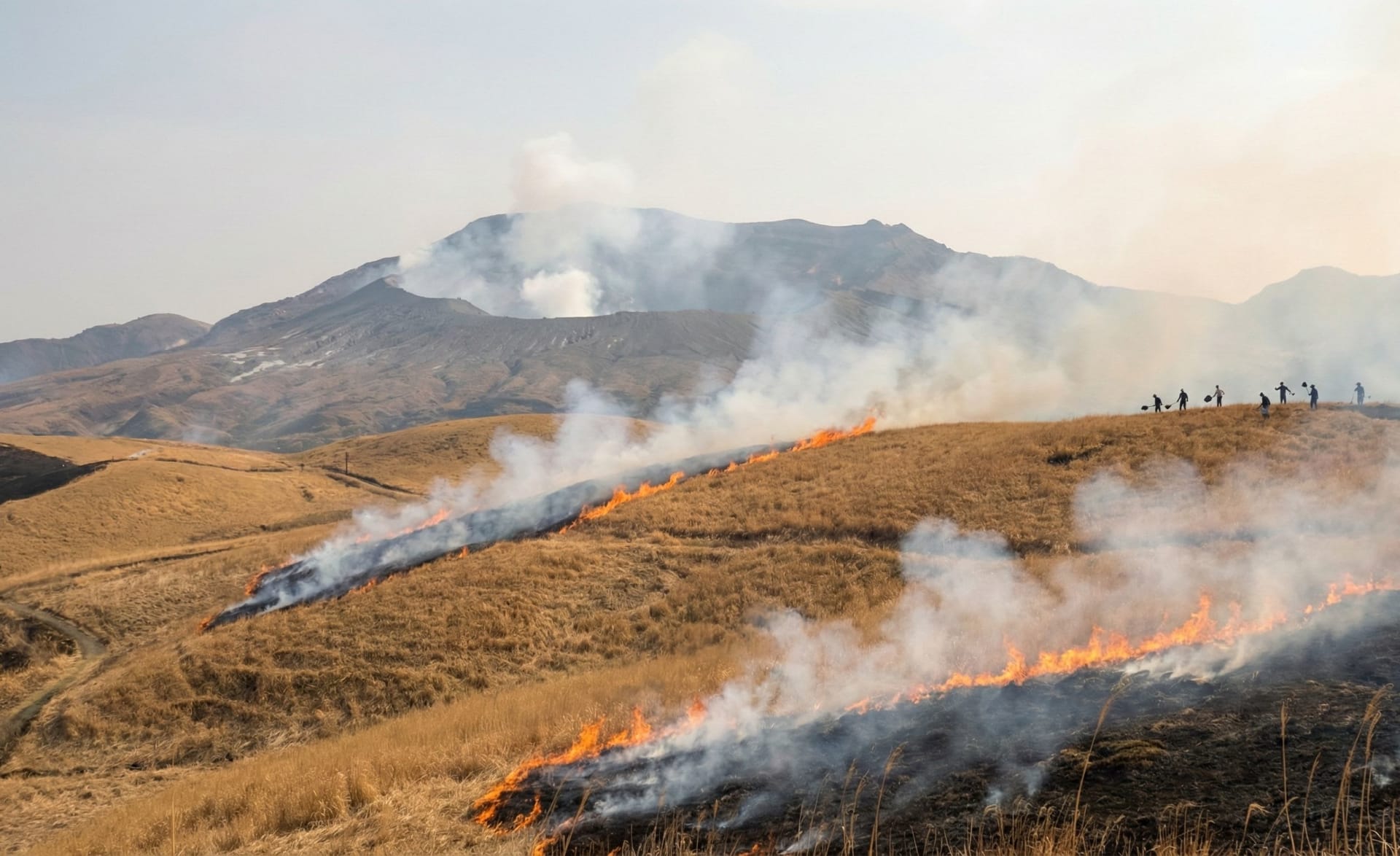
The line of fire crawls up the slope like a living thing. It moves fast, faster than you'd think, a low orange wave eating through dead winter grass. Within minutes, the entire hillside is wrapped in smoke and flame. Flames can reach 30 meters high . Then it's over. The caldera wall that was gold and brown an hour ago is now charcoal black. By April, it will be green again. This is Noyaki, Aso's controlled grassland burning, and it happens every March across 22,000 hectares of one of the world's largest inhabited calderas.
The Science Behind Aso Noyaki
Noyaki begins every year in March, burning away remaining withered grass to assist the sprouting of new grass . The practice targets the aboveground dead biomass while leaving underground root systems intact. Under the pitch black ash, grass whose underground stems are developing begins to sprout in less than a month .
The fire moves quickly through the dry Miscanthus sinensis (susuki) and Pleioblastus dwarf bamboo that dominate Aso's grasslands. The ash covering the land serves as a nutrient, and the black soil found in Aso's grasslands, called kurobokudo, is rich with fine charcoal particles, the result of prescribed burning . This carbon accumulation is what makes Aso's soil different from naturally occurring grasslands elsewhere.
Research into the soil strata has revealed that in Aso, controlled burning has been practiced for about 10,000 years, and this ancient ritual has led to the accumulation of immense amounts of carbon in the soil . The soil's carbon content is so high that the CO2 absorption of grasslands where controlled burning is practiced is about 6.9 tons per hectare per year, and the grasslands sequester 1.7 times the amount of carbon dioxide emitted annually by all households in Aso .
The process is more complex than just lighting a match. Before Noyaki, firebreak belts are created to prevent fire from spreading to nearby mountain forests or buildings through a process called wachikiri, cutting grass over a width of 6 to 10 meters, followed by wachiyaki, burning the cut grass in the belts a few days later . This preparatory work happens on steep slopes and requires hundreds of volunteers.
When and Where to See Aso Noyaki
Noyaki begins all over Aso every year in March , though between mid-February and March, it's noyaki season when local communities undertake controlled burnings . The exact dates shift with weather conditions, particularly wind speed and humidity, so there's no fixed schedule you can plan around months in advance. Check with the Aso City Tourism Association or the Aso Volcano Museum for current burn schedules as you get within two weeks of your visit.
Kusasenri Grassland (32.8833, 131.05) is one of the most accessible viewing locations. The wide plateau sits at the base of Mount Aso's central peaks, and burns here typically happen mid-morning to early afternoon. You can watch from designated viewing areas along the road, but arrive early. By 9am on burn days, parking lots fill fast.
Mount Aso Smoke Observation Park (32.880327, 131.074299) gives you elevation and sightlines across multiple burn zones. From here, you can see fires moving across distant ridges simultaneously, smoke columns rising from different sections of the caldera rim.
The town of Aso (32.952121, 131.121196) serves as your base. From Kumamoto Station, take the JR Hohi Main Line to Aso Station (about 1.5 hours). Rent a car at the station. Public buses run to Kusasenri, but they won't get you to smaller burn sites or let you move between locations as fires progress.
Burns typically start between 9am and noon, depending on wind and moisture conditions. Morning light is harsh and flat. The best light for photography hits around 3pm when the sun angles lower and the smoke takes on dimension.
Your Witnessing Guide
Stay behind barriers. Fire crews will have designated viewing zones marked, and they're not suggestions. Fires can reach heights of 30 meters , and wind shifts without warning.
Bring a mask rated for smoke, not a surgical mask. The kind with a valve that filters particulates (N95 or better). The smoke is thick, carries ash, and can irritate your throat for hours if you're exposed without protection. Eye protection helps too. Wraparound sunglasses at minimum, safety goggles if you're planning to get close to active burn lines.
Camera settings: ISO 400, shutter speed 1/500 or faster to freeze the flame movement, aperture f/8 for depth across the hillside. If you're shooting the smoke columns against blue sky, meter for the sky and let the foreground go slightly dark. A telephoto lens (200mm or longer) compresses the scene and makes distant fire lines look more dramatic. A wide lens (24mm or wider) works for the scale shots where you want the entire caldera rim in frame with multiple burns happening at once.
Bring water. More than you think. The air is dry, you'll be standing in sun and smoke, and hydration matters when you're breathing particulates. Layers, too. March in Aso is cold in the morning, warm by midday, and the wind on the caldera rim cuts through a single jacket.
Tripod is optional unless you're planning to shoot long exposures of the smoke movement after the flames have passed. Most of the action happens fast enough that handheld works fine.
Why Aso's Grasslands Matter
This tradition, which has been around for over a thousand years, maintains the grasslands as pasture for cattle and spreads fertilizing carbon onto Japan's young soils, enabling the evolution of a specific and unique ecosystem . Without fire, the grasslands would turn into forests .
Approximately 600 plant species grow here, and the traditional practices of hay mowing and noyaki enable the growth of a great variety of flowering plants, attracting many species of animals, birds and insects . Species that depend on this fire-maintained ecosystem include the endangered Shijimiaeoides divinus large blue butterfly, the Kyushu-ezozemi cicada, and Daikoku-kogane scarab beetle , all of which live on the border between grassland and forest.
The Akaushi cattle that graze these grasslands from April to December are part of the cycle. Around 7,000 head of cattle graze the land from April until December . Their grazing keeps vegetation low between burns, and their manure adds nutrients the fire alone can't provide.
The grasslands have a unique ability to store rainwater in the soil and slowly release it to rivers, managing water during heavy rains and continuing to provide moisture even in dry periods, more effectively than forests . With an annual rainfall of about 3,000 mm, the rain absorbed by the mountains feeds into six major rivers that are vital for the water supply of nearly 5 million people in the area .
Noyaki is tied to local Shinto practice. The Aso no Himatsuri festival has its origin in the month of March festivals such as Aso no Noyaki and Aso jinja no Hifuri shinji, the fire ritual of Aso Shrine . The shrine itself, traditionally said to have been established in 281 BC , sits within the caldera and has held fire rituals connected to the agricultural calendar for centuries.
The challenge now is volunteer availability. Though traditionally performed by farmers, Noyaki today strongly relies on volunteers and locals to maintain the grasslands . Younger generations leave for cities, and the knowledge required to safely execute a hillside burn is specific. Organizations like the Aso Grassland Conservation Center run training programs, but the labor pool shrinks each year.
This is the short version
This page shows a taste. The app has the full list of where to see this, the exact timing, and live conditions for 1,000+ natural phenomena worldwide, so you know the moment one is genuinely worth the trip.