As of today, out of season, returns ~April. Earth Exhibit tracks the live conditions and flags it the moment it is on.
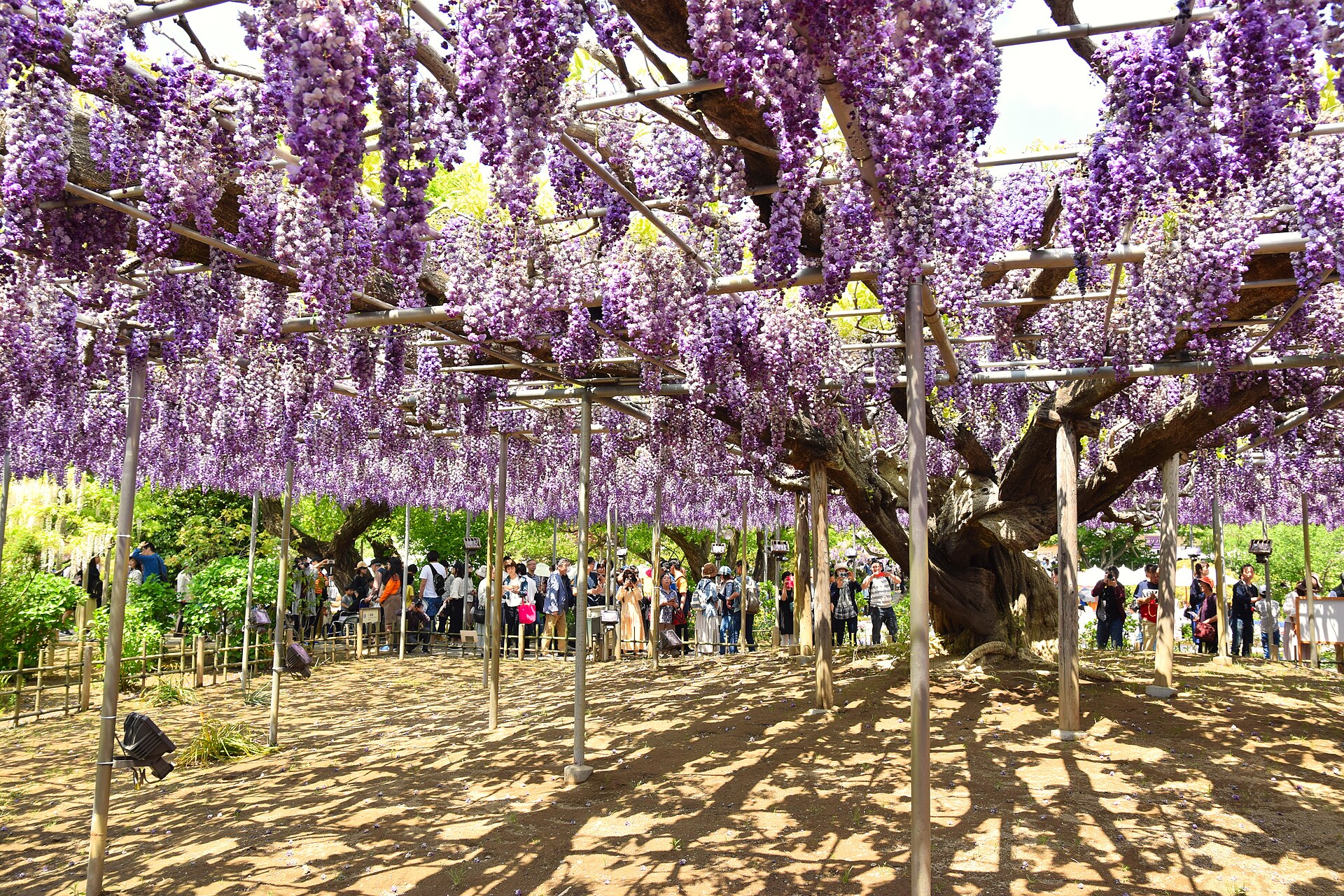
You walk through the entrance gate and the sky disappears. Not gradually. The steel trellis overhead supports a single wisteria vine (Wisteria floribunda) that has been growing for more than 150 years, and its canopy now covers over 1,000 square meters. Racemes hang 1.5 meters down from every branch, dense enough to block the sun. The light that filters through is purple. The air smells sweet and faintly spicy, the kind of fragrance that thickens in your throat. A Japanese carpenter bee (Xylocopa appendiculata) the size of your thumb bumps past your ear, heading deeper into the canopy. You are standing inside a single organism, and it is in full bloom.
Ashikaga Flower Park in Tochigi Prefecture opens its wisteria displays each April, but the two weeks between April 20 and May 3 are something different. That is when the Great Wisteria hits peak raceme density, and the park becomes one of the most concentrated floral spectacles in Japan.
How a Legume Builds a Purple Ceiling
Wisteria floribunda is a woody climbing vine in the Fabaceae family. The same family as soybeans, chickpeas, and clover. Like its relatives, wisteria forms symbiotic relationships with Rhizobium bacteria in root nodules, fixing atmospheric nitrogen into soil-available ammonia. This gives the plant a metabolic advantage in poor soils: it manufactures its own fertilizer. That advantage, compounded over 150 years of growth, is how a single vine came to dominate an area larger than most residential lots.
The flowers grow as racemes, elongated clusters that develop from the base outward. On the Great Wisteria, individual racemes reach 1 to 2 meters in length, with the longest specimens pushing closer to the upper limit. Each raceme contains dozens of papilionaceous (butterfly-shaped) flowers, opening sequentially from top to bottom over roughly ten days. The color deepens toward the tips where buds are still developing, creating a natural gradient from pale lavender at the top to rich violet at the bottom.
The park grows multiple cultivars with staggered bloom timing. Purple wisteria (fuji) peaks first, around April 20. White wisteria (shiro-fuji) and pink (usu-beni) follow within days. Double-petaled varieties (yae) overlap the mid-period. Yellow wisteria (ki-fuji) arrives last, reaching full display around late April to early May. The result is a rolling bloom that sustains peak conditions for roughly two weeks rather than the four or five days you might get from a single cultivar.
The Great Wisteria's canopy requires an engineered steel trellis system to stay aloft. Without it, the vine's own weight would tear it apart. Wisteria is aggressive. It twines clockwise (distinguishing W. floribunda from the counterclockwise American W. frutescens), and its stems generate enough torsional force to crush metal pipes over decades. The park's maintenance crew monitors the trellis year-round, adjusting supports as new growth shifts the weight distribution. The vine does not stop growing because the canopy is large. It stops growing because the trellis defines where it can go.
When and Where to See the Superbloom
Core bloom window: April 20 to May 3. The broader wisteria season runs April 10 through May 10, but early April catches only partial development and late May finds spent racemes browning at the tips. If you have a single trip to plan, target the last week of April.
Ashikaga Flower Park sits at 36.31N, 139.52E in Ashikaga, Tochigi Prefecture. Three main display areas concentrate the spectacle:
- Great Wisteria Canopy Main Display: The 150-year-old vine and its trellis. This is the centerpiece. Expect the densest crowds here, particularly between 10 AM and 2 PM.
- Wisteria Tunnel and Trellis Walks: Long corridors of trained wisteria forming overhead canopies you walk through. The white wisteria tunnel (80 meters long) is the most photographed section after the Great Wisteria itself.
- Evening Illumination Area: After sunset, the park lights the canopies from below. The illumination period typically runs from 5:30 PM until 9:00 PM during peak bloom.
Getting there: JR Ashikaga Flower Park Station sits directly adjacent to the park entrance, about 80 minutes from Tokyo's Ueno Station via the JR Utsunomiya Line and transfer at Oyama. During wisteria season, direct temporary trains sometimes run. A car from Tokyo takes roughly 90 minutes without traffic via the Tohoku Expressway, but parking fills early on weekends.
Timed-entry tickets are required during peak bloom. The park switched to this system to manage crowd density. Purchase tickets online in advance. Walk-up availability is not guaranteed, especially on weekends and holidays during Golden Week (late April to early May), when domestic tourism across Japan surges. Ticket prices vary by bloom stage, with peak-bloom admission higher than shoulder dates.
Best time of day: Early morning (park opening) or the evening illumination window. Midday is the worst for both crowds and photography. The morning light is softer, the crowds thinner, and the bees are just waking up. Evening brings a completely different experience: the racemes glow under purple and white spotlights, and the reflections in the park's ponds double the visual impact.
Your Witnessing and Photography Guide
The park is flat, paved, and wheelchair-accessible on all main paths. Comfortable walking shoes are sufficient. You will be on your feet for two to four hours if you explore thoroughly.
What to bring:
- Camera with a wide-angle lens (14-24mm) for canopy shots looking straight up
- A macro lens or close-focusing zoom for individual raceme detail
- Tripod (essential for evening illumination; optional during daylight)
- Water and sunscreen (the canopy provides shade, but the walks between displays do not)
- A hat for midday visits
- Patience for the crowds
Daylight Settings
For the canopy overhead shots, you are shooting into filtered light. ISO 100-400, f/5.6 to f/11 gives you the depth of field to keep racemes sharp from foreground to background. The purple light creates a strong color cast. Shoot in RAW and white-balance in post. The camera's auto white balance will try to correct the purple into neutral tones, which kills the entire mood of the image.
For tunnel close-ups and isolated raceme portraits, open up to f/2.8 to f/5.6 to separate a single cluster from the background. Use a telephoto (85-200mm) to compress the depth of the tunnel, stacking layers of hanging racemes into a dense wall of color. Arrive before 8 AM for this shot. Later in the morning, foot traffic disrupts clean compositions.
Evening Illumination Settings
This is where a tripod earns its weight. ISO 400-1600, f/2.8 to f/5.6, shutter speeds between 1 and 3 seconds. The illumination is bright enough for the eye but dim for sensors. Longer exposures smooth out any breeze-induced movement in the racemes, which can work for or against you. A half-second exposure in light wind creates a soft, painterly effect. A three-second exposure in stronger wind turns the racemes into purple smears.
The pond reflections are the signature evening shot. Position yourself at the water's edge with the illuminated Great Wisteria reflected in the surface. Even a slight breeze fractures the reflection into impressionistic streaks. Windless evenings produce mirror-perfect doubles, but those conditions occur maybe one night in five during peak season. Go multiple evenings if you can.
One practical frustration: the park bans tripods in certain high-traffic areas during peak hours. Check the current restrictions at the entrance. Monopods are generally tolerated where tripods are not.
The Bigger Picture
Wisteria holds deep cultural weight in Japan. The Fujiwara clan, one of the most powerful families in Japanese history, took their name from the plant (fuji meaning wisteria, wara meaning field). Wisteria motifs appear on family crests, kimono patterns, kabuki stage designs, and the current Japanese 5,000-yen banknote. The plant's cascading form, graceful but structurally tenacious, became a symbol of resilience wrapped in beauty.
Ashikaga's Great Wisteria was transplanted to the park in 1996 when the original site faced urban development. Moving a century-old wisteria vine is an enormous undertaking. The root system was excavated over months, and the transplant required custom engineering to preserve the root ball integrity. The vine survived. Twenty years later, its canopy is larger than ever.
Ecologically, wisteria serves as a critical early-season nectar source for pollinators. The Japanese carpenter bee (Xylocopa appendiculata) is the primary pollinator of W. floribunda, and the two species have coevolved: the bee's body weight is sufficient to depress the flower's keel petal and access the nectar, while lighter insects cannot trigger the mechanism. Watch the canopy carefully and you will see these bees working methodically through the racemes, their abdomens dusted gold with pollen.
The nitrogen-fixing root nodules mean the Great Wisteria enriches the soil beneath it continuously. The microbial community in the root zone of a 150-year-old specimen is likely orders of magnitude more complex than anything in the surrounding landscape. The vine has been engineering its own soil for a century and a half.
Climate is shifting bloom timing. Parks across the Kanto region have reported wisteria blooming three to five days earlier than historical averages over the past decade. The April 20 to May 3 core window is a moving target. In warm years, full bloom can arrive by April 15. Check the park's official bloom-status updates in the days before your visit rather than trusting fixed calendar dates.
If you stand under the Great Wisteria at peak bloom, looking straight up through 1,000 square meters of purple racemes while carpenter bees hum through the canopy overhead, you will understand why one plant, one organism, warranted an entire park built around it. Few living things on Earth produce this density of flower per square meter of sky.
This is the short version
This page shows a taste. The app has the full list of where to see this, the exact timing, and live conditions for 1,000+ natural phenomena worldwide, so you know the moment one is genuinely worth the trip.