As of today, peak season now, through ~June 30. Earth Exhibit tracks the live conditions and flags it the moment it is on.
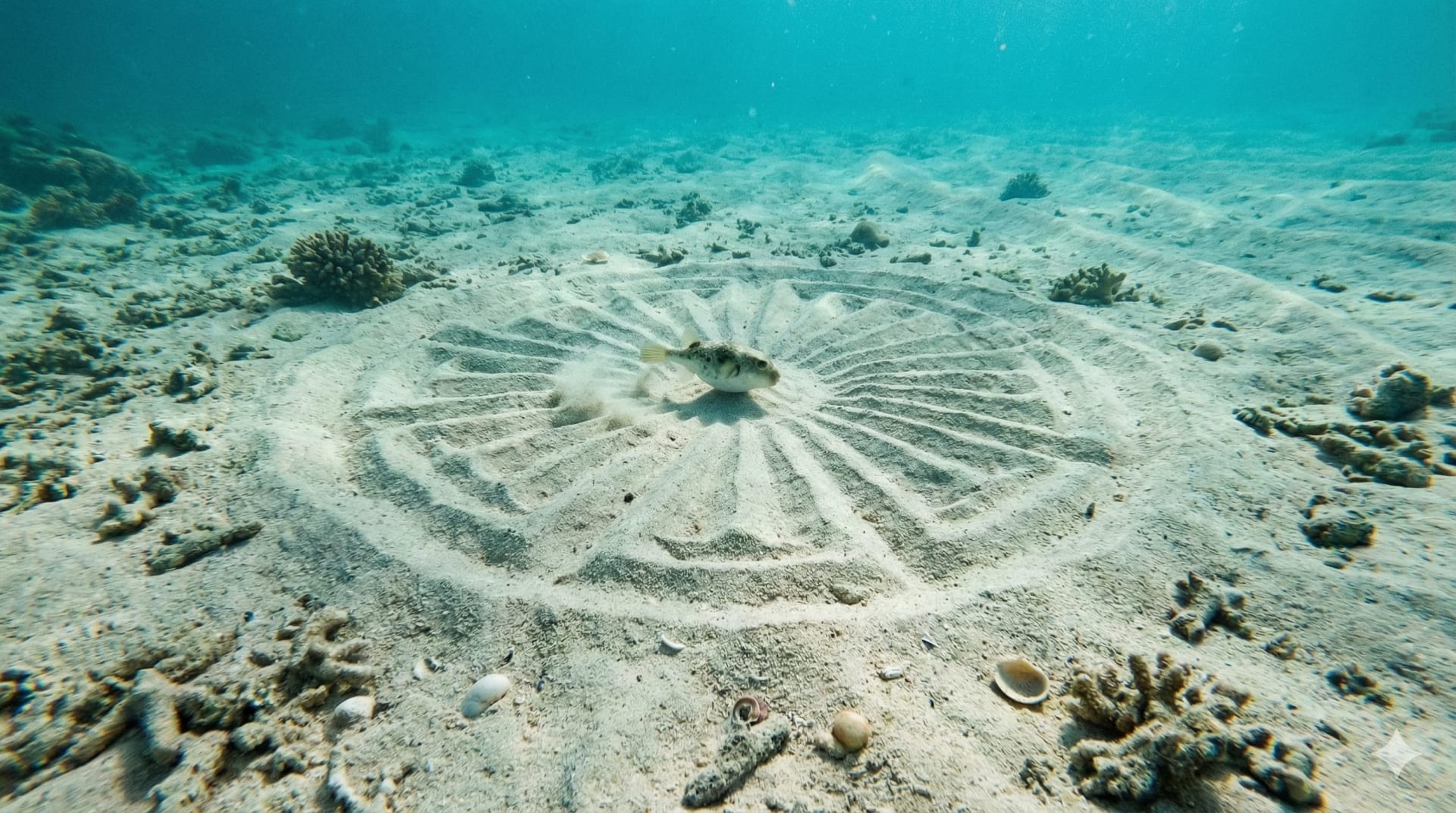
Fifteen meters below the surface off Amami Oshima, the sandy bottom looks unremarkable. Gray sediment, scattered coral rubble, the occasional sea cucumber. Then your dive guide taps her tank with a pointer and aims her light downward. There it is. A perfect geometric mandala etched into the seafloor, two meters across, with radiating ridges fanning outward like the spokes of a wheel drawn by a compass. And hovering just above the center, finning in nervous little bursts, is the artist: a pufferfish smaller than your hand.
You hang motionless in the water column, breathing slow, watching a 12-centimeter fish put the finishing touches on something that took him over a week to build. He nudges a fragment of broken shell into place along one ridge. Backs up. Surveys. Adjusts. The precision is almost unsettling. Nothing else in the animal kingdom looks like this.
The Science of Underwater Geometry
Until 2012, nobody knew what made these structures. Divers off the Amami Islands in southern Japan had been photographing the circles for years, but the builder remained a mystery. The patterns were so large and so geometrically precise that early speculation ranged from underwater currents to unknown geological activity. Then a research team led by Hiroshi Kawase at the Coastal Branch of the Natural History Museum and Institute, Chiba, finally caught the architect in the act.
The species is Torquigener albomaculosus, a white-spotted pufferfish formally described as new to science in 2014. Males of the species are roughly 12 centimeters long. The nests they construct can reach up to 2 meters in diameter. That ratio is staggering. Scaled to human proportions, it would be like a single person building a structure 30 meters across using only their body.
The construction process takes 7 to 9 days. The male begins by swimming along the sandy bottom, using his pectoral and anal fins to carve radial furrows outward from a central point. He works in expanding passes, creating a series of ridges and valleys that fan out in a symmetric pattern. The geometry is not decorative. It is functional. The radiating ridges act as channels that funnel fine-grained sediment particles toward the center of the circle, creating a bed of unusually fine sand where the female will eventually lay her eggs. Coarser particles stay in the outer ridges. The nest is, in effect, a sediment sorting machine.
Once the basic architecture is finished, the male begins decorating. He collects small shell fragments and places them along the peaks of the ridges and around the central area. Researchers believe this serves as both a visual signal to females and a structural reinforcement that prevents the ridges from collapsing.
Females choose mates based on the quality and size of the completed circle. Larger, more symmetric patterns with finer central sediment correlate with mating success. After a female selects a nest, she lays her eggs in the fine sand at the center. The male guards and tends the eggs. Then, within days of the eggs hatching, he abandons the structure entirely and starts building a new one from scratch at a different location on the seafloor.
The circles degrade within a week of abandonment. Every single one you see is either under active construction or freshly completed. There are no old ones. They are as temporary as they are precise.
When and Where to See Them
The circles appear on sandy bottom areas at 10 to 30 meters depth around Amami Oshima, the largest island in the Amami archipelago, located roughly halfway between Kyushu and Okinawa in Kagoshima Prefecture.
Peak season runs from late May through late June, with the core window falling between approximately May 20 and June 25. Activity can extend into July in some years, but by then the frequency drops off significantly. Water temperatures in this period sit around 24 to 27 degrees Celsius, warm enough for a 5mm wetsuit to be comfortable on most dives.
Three dive operations provide reliable access to known nesting sites:
- Diving Shop Native Sea Amami (28.43 degrees N, 129.62 degrees E), located on the eastern coast of Amami Oshima. This operation has been documenting the circles for years and knows the seasonal nesting areas well.
- Amami City base (28.38 degrees N, 129.49 degrees E), on the western side of the island, with access to sandy bottom sites along the coast.
- Aqua Dive Kohollo (28.17 degrees N, 129.30 degrees E), operating from the southern end of the island near Setouchi.
You will need at minimum an Open Water dive certification (PADI, SSI, or equivalent). Most circle sites sit in the 15 to 25 meter range, well within recreational limits, though an Advanced Open Water certification gives you more flexibility and is recommended. Book dive guides who specifically know the nesting locations. The circles are not visible from the surface, and the sandy bottom where they occur can stretch for hundreds of meters. Without a guide who has been tracking active construction sites, you could dive the same reef ten times and never see one.
Visibility is typically best in the morning, before afternoon winds chop up the surface and suspended particles drift into the water column. Plan your circle dives as the first boat of the day when possible.
Logistics: Amami Oshima has a commercial airport (ASJ) with daily flights from Osaka, Tokyo Narita, and Kagoshima. Accommodation ranges from small guesthouses to a handful of resort hotels. An eSim or pocket WiFi is strongly recommended, as English-language signage and service outside the dive shops is limited. June is technically early rainy season in the Amami Islands, so pack accordingly and build in weather buffer days.
How to Photograph Them
The circles present a unique underwater photography challenge. The subject is large, flat, low-contrast, and sits on a featureless background. Getting a compelling image requires thought about angle, lighting, and lens choice.
Use a wide-angle lens. A full circle at two meters diameter fills the frame of a 10-14mm rectilinear wide angle from about 1.5 to 2 meters above the subject. Fisheye lenses (like the popular Tokina 10-17mm) work but introduce barrel distortion that undermines the geometric precision that makes the circles remarkable. If you have both, try both, but the rectilinear shots tend to be more striking.
The overhead angle is the money shot. Position yourself directly above the center of the circle, looking straight down. This is the angle that reveals the full radial symmetry. It requires good buoyancy control. You need to hover motionless at 1.5 to 2 meters above the sandy bottom without kicking up sediment. Any fin contact with the substrate will cloud the water and ruin visibility for 10 to 15 minutes.
Bring a dive light, even on bright days. Raking light from a low angle across the ridges dramatically increases the visible texture and contrast of the sand structure. Hold the light out to one side at a 20 to 30 degree angle to the bottom while shooting. The shadows along the ridge-and-valley pattern are what make the geometry pop.
Shoot video. Still photos show the finished product, but the construction behavior is where the real story lives. A male pufferfish methodically carving furrows, placing shell fragments, and backing up to assess his work is compelling footage. Shoot in 4K if your housing supports it. The fine details of sediment displacement are visible in 4K that get lost in 1080p.
Do not disturb an actively building male. If you see a fish mid-construction, keep your distance (at least one meter) and avoid sudden movements. A spooked male may abandon a nest he has spent days building. The guides will brief you on approach distances. Follow their lead. These animals have been studied in part because the dive operators have maintained responsible observation protocols that keep the fish building in known areas year after year.
Why This Matters Beyond the Ocean Floor
For decades, complex tool use and architectural construction were considered hallmarks of higher cognition. Birds build nests. Great apes fashion probes. Beavers engineer dams. But a pufferfish the size of a deck of cards, operating with a brain smaller than a pea, producing a geometrically precise structure 16 times its own body length? That forced a recalibration.
The discovery of Torquigener albomaculosus and its nest-building behavior was published in Scientific Reports in 2014, and it immediately became one of the most widely cited examples of complex construction behavior in fish. It challenged assumptions about the cognitive requirements for building, about sexual selection as a driver of architectural complexity, and about how much of the marine world remains undocumented even in well-studied regions like southern Japan.
Amami Oshima itself sits within a UNESCO World Natural Heritage area (inscribed in 2021) that encompasses the unique subtropical ecosystems of the Amami and Ryukyu islands. The pufferfish circles are part of a broader story of biological richness on these islands, from the endangered Amami rabbit (Pentalagus furnessi) in the forests above to the coral reef systems offshore.
The circles also carry a quieter lesson. They were there for years before anyone identified the builder. Divers saw them, photographed them, and moved on. The phenomenon was hiding in plain sight, 15 meters down, on a sandy patch that most divers would swim right over on their way to the reef. The ocean floor is full of things we have not thought to look for yet. Amami's pufferfish circles are proof that some of the most extraordinary animal behaviors on the planet are still waiting to be noticed by the right pair of eyes at the right time.
This is the short version
This page shows a taste. The app has the full list of where to see this, the exact timing, and live conditions for 1,000+ natural phenomena worldwide, so you know the moment one is genuinely worth the trip.