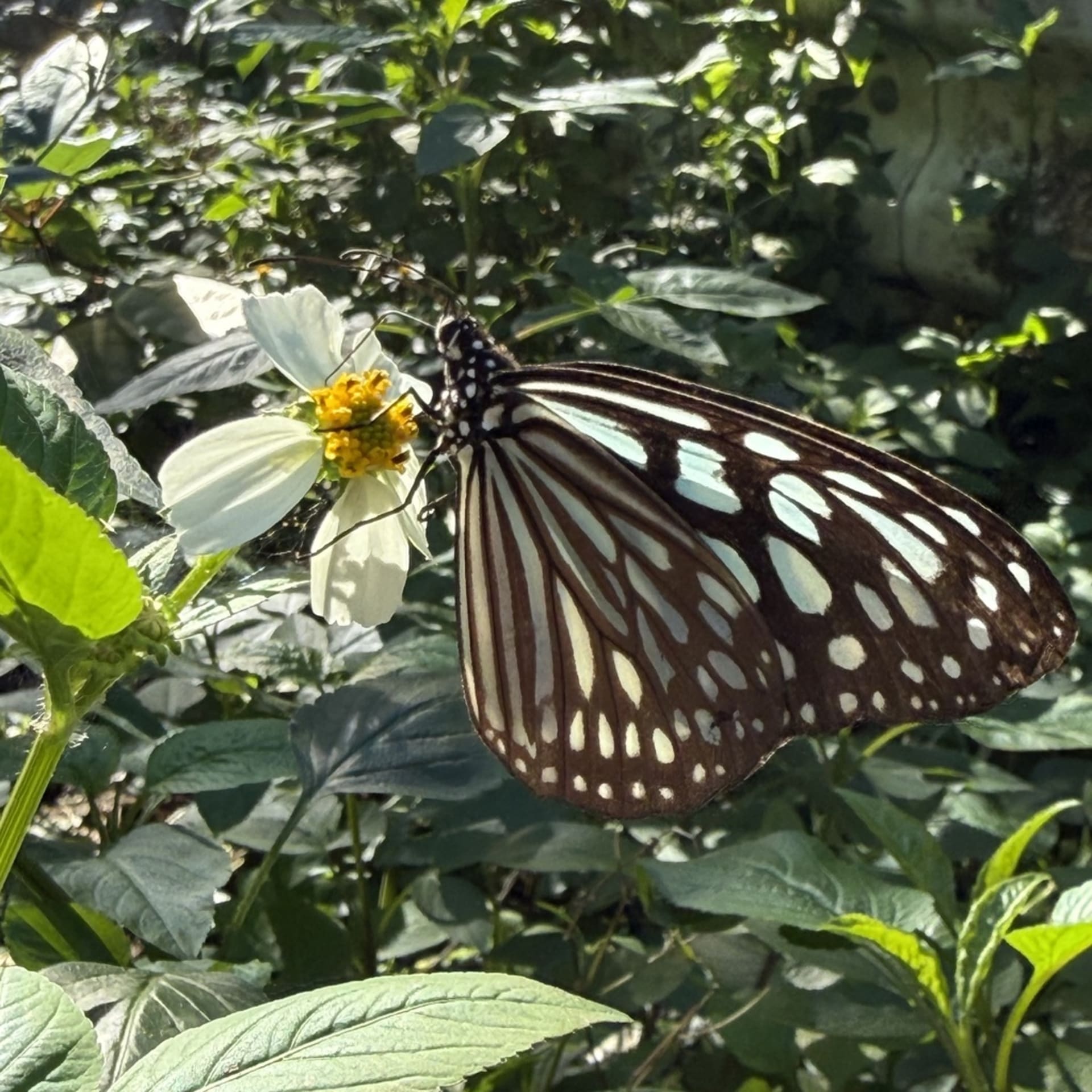
As of today, out of season, returns ~November. Earth Exhibit tracks the live conditions and flags it the moment it is on.
The gully is dim even at midday, canopied by tree ferns and evergreen oaks. Then you see them: hundreds of Ceylon blue glassy tigers clinging to a single trunk, wings folded, pale blue markings catching the filtered light. More hang from branches overhead, clusters thick enough that twigs sag under their collective weight. This is overwintering, and Amami Oshima's ravines hold one of southern Japan's most remarkable butterfly aggregations from December through February.
The Science Behind Blue Glassy Tiger Overwintering
Ideopsis similis similis, the subspecies found on Amami Oshima, belongs to the Danainae (the tiger and crow butterflies), whose larvae feed on milkweed-family plants containing toxic cardenolides. Adults retain these compounds, advertising their unpalatability with high-contrast wing patterns: black venation overlaying blue and translucent glass-white scales. The wing pattern is consistent across both sexes, and the body displays the characteristic black-and-white spots that signal toxicity to predators.
Overwintering in clusters is a thermoregulatory and anti-predator strategy. By grouping in shaded, humid ravines where temperatures remain moderated, typically between 12 and 18 degrees Celsius during Amami's mild winter, the butterflies reduce metabolic costs. Clustering also creates a visual amplification of the aposematic signal: a single butterfly might be overlooked, but a mass of hundreds becomes unmistakable. The behavior is site-faithful. The same gullies host clusters year after year, suggesting either chemical cues or landscape features that butterflies recognize and return to.
On Amami Oshima, the species feeds as larvae on native Asclepiadaceae, including Tylophora ovata. Adults emerge in warmer months, mate, and disperse. As winter approaches and temperatures drop, they seek out protected ravines in the island's remaining evergreen broadleaf forest. Activity slows. They remain sedentary through the coolest months, only occasionally shifting position or flying short distances when disturbed. By late February, as temperatures climb, the clusters begin to break up and individuals resume normal feeding and reproductive behavior.
When and Where to See Amami Blue Glassy Tiger Clusters
The core season runs from December to February , with peak cluster density typically in January when temperatures are lowest and butterflies are most tightly aggregated. Morning visits offer the best viewing, as clusters are most stable and butterflies least active in the cool, calm hours after dawn.
The primary viewing sites are:
Kinsakubaru (Nakagawa/Kinsakubaru Ridge) Roost Gullies: The most accessible and well-known site, located in the central part of Amami Oshima. Unguided access to Kinsakubaru Virgin Forest is prohibited; booking a guided tour is mandatory for all visitors . Kinsakubaru Forest can be reached by car in about 30 minutes from Naze, Amami Oshima's central city . Certified eco-tour guides lead 90-120 minute walks through restricted areas, and many can point out butterfly roosts along the trail. As of early 2026, English-speaking guides are available through companies like Link Adventures, though they remain scarce .
Kasari River Valley Ravines (Amami City outskirts): Smaller, less-visited gullies on the northern end of the island. Access requires local knowledge; hiring a guide familiar with the area is strongly recommended. The terrain here is steeper and trails are less maintained than at Kinsakubaru.
Sumiyo Mangrove Ravine Viewing Spot (Southwest sector): Roosts near the mangrove forest zone in the southwestern part of the island. This area combines butterfly watching with mangrove kayaking tours, though the roosts themselves are inland in adjacent ravines, not in the mangrove itself.
Fly into Amami Airport (ASJ) from Kagoshima (KOJ) or Naha (OKA). Rental cars are essential for flexibility, as driving times from the airport to roost areas range from 20 to 60 minutes depending on the site. Taxis and limited buses connect Amami City (Naze) with rural villages, but schedules are infrequent.
Your Witnessing Guide
What to bring: Binoculars are essential, as many clusters form high in tree canopies or on trunks several meters off the ground. A camera with a zoom lens (at least 200mm equivalent) will allow you to photograph clusters without approaching closely. The subtropical forest is humid and can be muddy, with sudden weather changes; wear sturdy sneakers, bring rain gear, and stay hydrated. Avoid sandals, as you might encounter snakes like the Habu . Long sleeves and pants provide protection from insects and scratching vegetation. Insect repellent is recommended, though apply it away from roost sites to avoid disturbing the butterflies.
Photography settings: In the dim understory, shoot at ISO 800-1600 to maintain a fast enough shutter speed (1/250s minimum) to freeze any wing movement. Aperture of f/4 to f/5.6 balances depth of field with light-gathering. Stabilization or a monopod helps in low light. Avoid using flash. It can startle clusters and cause them to disperse.
Safety and etiquette: Trails to roost gullies can be steep and slippery after rain. Habu snakes are venomous and mostly active at night, but remain vigilant during daytime forest walks. Guides offer invaluable insights and can lead you to hidden spots . Most critically: do not approach or touch clusters. Disturbance can cause butterflies to break formation and expend precious energy reserves. Speak quietly, move slowly, and keep at least 3-5 meters from aggregations. Never shine bright lights directly on clusters.
Best time of day: Early morning, between 7am and 10am, offers the most stable viewing conditions. Butterflies are quiescent in the cool morning air, and light is softer for photography. By midday, warming temperatures can trigger sporadic activity. Afternoon visits are less predictable but still viable, especially on cooler or overcast days.
Why It Matters
Overwintering aggregations are ecological indicators of habitat quality. The fact that blue glassy tigers return to the same ravines year after year means those sites provide the precise microclimate (stable humidity, moderated temperature, protection from wind) that the butterflies require. Any disturbance to the forest canopy or hydrology of these gullies could disrupt the behavior.
The species ranges across Asia, including Sri Lanka, India, Taiwan, and Southeast Asia , but the overwintering clusters on Amami Oshima represent a northern population adapting to subtropical winter conditions. The butterflies' reliance on native Asclepiadaceae host plants makes them vulnerable to habitat loss and invasive species. Amami Oshima was designated a UNESCO World Heritage site in 2021 as part of the Amami-Oshima, Tokunoshima, Northern Okinawa Island, and Iriomote Island complex, recognizing its high endemism and biodiversity. The blue glassy tiger clusters are one visible emblem of that richness.
Culturally, the butterflies hold less prominence than Amami's endemic mammals (the Amami rabbit, for instance, draws far more attention), but local naturalists and tour guides increasingly highlight the clusters as a winter spectacle unique to the island. The phenomenon also underscores the importance of secondary-growth and recovering forests. Kinsakubaru is a forest in recovery long after people cut down trees, now striving to restore its original evergreen broadleaf forest . The butterflies' presence is a sign that restoration is working.
Conservation challenges remain. Amami's forests face pressure from development, invasive predators like feral cats and mongoose, and climate shifts that could alter the temperature and humidity regimes the butterflies depend on. Roost sites are fragile. A single disturbance event (whether from human intrusion, habitat clearing, or predator introduction) can scatter a cluster and potentially disrupt site fidelity for subsequent winters.
If you're drawn to the idea of spending winter mornings watching pale blue wings fill a subtropical ravine, you're not alone. Amami Oshima offers more than just butterflies. The island is home to endemic birds, frogs, plants, and ecosystems found nowhere else. Exploring these forests responsibly means hiring certified guides, respecting access restrictions, and understanding that your visit helps fund the conservation work that keeps these phenomena intact. Track live conditions for this and 940+ phenomena on the Earth Exhibit app: https://earthexhibit.com
For those considering deeper engagement with Japan's natural heritage, Settle Japan (https://settlejapan.com) provides relocation resources and practical guidance for living near some of the country's most ecologically significant regions. And if you want on-the-ground footage of Japan's seasonal spectacles, follow @johnofjapan on Instagram (https://instagram.com/johnofjapan) for real-time updates from the field.
This is the short version
This page shows a taste. The app has the full list of where to see this, the exact timing, and live conditions for 1,000+ natural phenomena worldwide, so you know the moment one is genuinely worth the trip.