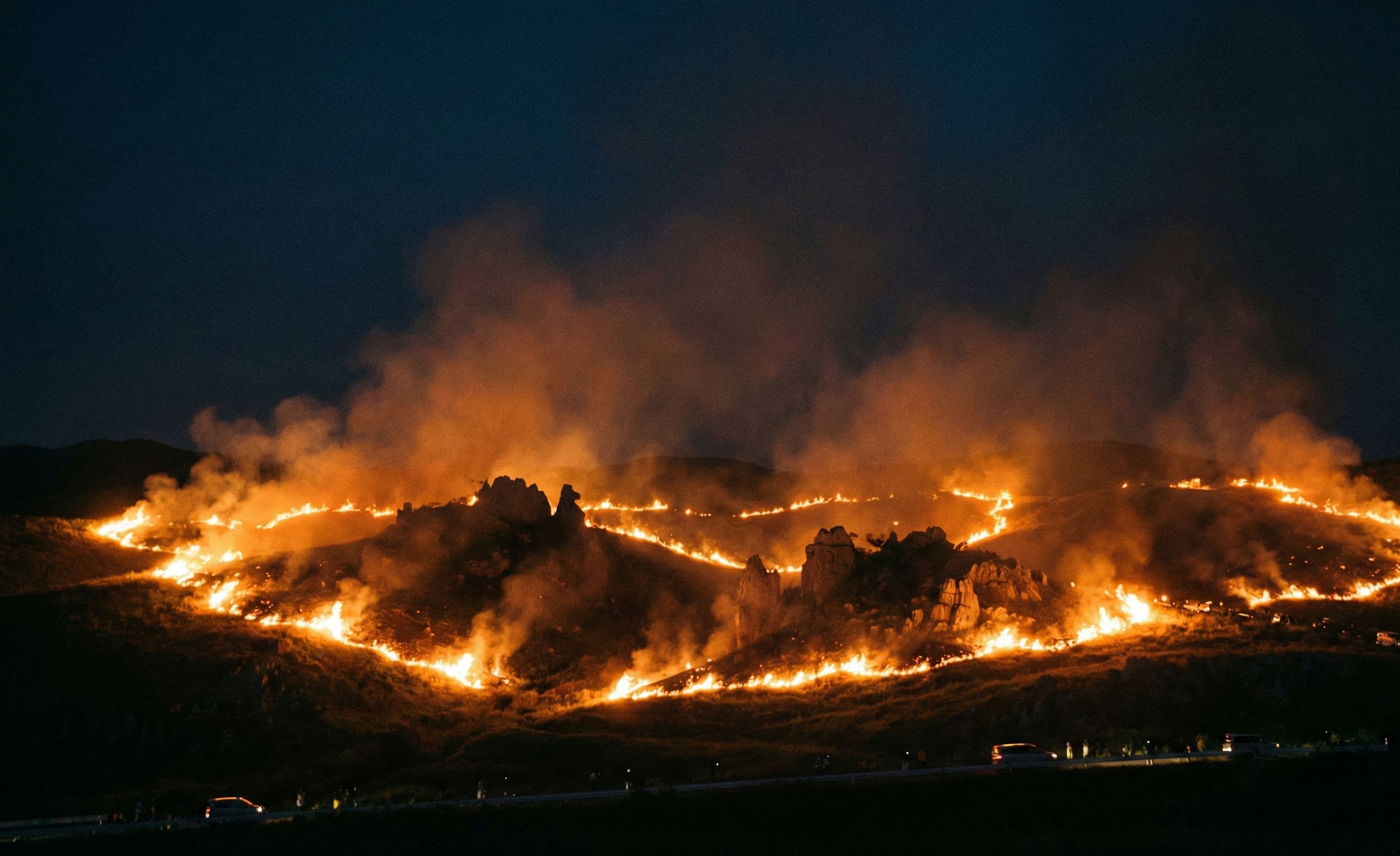
The first wave of flame crawls uphill through dead winter grass, throwing orange light across white limestone pinnacles. Then another ignition line sparks 100 meters away, and another, until the entire Akiyoshidai karst plateau is ringed with fire. On the third Sunday in February, a controlled burn is conducted at Akiyoshidai to conserve the grasslands , and what land managers do for ecological necessity also happens to be one of western Honshu's most dramatic fire spectacles.
Akiyoshidai karst plateau is the largest karst plateau in Japan , a 130-square-kilometer expanse of grassland punctuated by limestone outcrops that formed from coral reefs 300 million years ago. The yamayaki (mountain burning) has been conducted here for over 600 years, preventing scrub encroachment and maintaining the open landscape that defines the plateau.
The Science Behind Akiyoshidai Yamayaki
The plateau was a coral reef an estimated 300 million years ago, and the karst topography that we see today is the result of the gradual dissolution of limestone by rain through the years . The white limestone pinnacles dotting the grassland are erosion-resistant remnants of ancient reef structures that once grew atop a submarine volcano far from any continent. The limestone was formed approximately 300 million years ago through the accumulation of carcasses of organisms such as coral that grew on top of a submarine volcano , and tectonic forces eventually pushed the entire formation onto land.
The grassland itself is not natural. It's the product of centuries of human intervention. Originally forested like most Japanese uplands, the plateau was cleared for cattle grazing centuries ago. The plateau is regularly burned in winter in order to prevent trees from growing back . Without the annual burn, woody shrubs would invade within a few seasons, shading out the grass and eventually returning the landscape to forest.
The controlled burn serves multiple ecological functions. It helps prevent shrubs and trees from overtaking the grasslands, preserving the open, rocky scenery of the karst plateau. The fire removes dead grasses from the previous year, reducing fuel loads and encouraging new growth, and helps reduce ticks and other pests. The heat stimulates dormant grass seeds and releases nutrients locked in last year's growth back into the soil. This open burning is aimed at maintaining the unique scenery of Akiyoshidai, exterminating pests, and protecting the ecosystem .
Fire also protects what lies beneath. Underneath the karst plateau is Akiyoshido Cave, one of the largest limestone caves in Japan that was formed as rainwater dissolved the limestone on the karst plateau and created an underground tunnel . The cave system extends 8.79 kilometers, making it one of Asia's longest. By preventing forest growth, the burn preserves the hydrology that feeds these caves. Trees would intercept rainfall and alter groundwater flow patterns that have shaped the cave over millennia.
When and Where to See Akiyoshidai Yamayaki
The controlled burn is conducted at Akiyoshidai on the third Sunday in February each year, typically landing mid-month. Weather determines everything; the event requires dry conditions and manageable wind. Postponements due to rain, high winds, or snow happen regularly, sometimes pushing the burn forward a week.
The controlled burning begins at around 10 a.m., with locals and city officials torching the grass with gas burners at multiple locations in the park . Multiple ignition points are lit simultaneously around the plateau perimeter, and the flames advance inward in coordinated bands. The burn typically lasts 1-2 hours depending on conditions, though the most visually dramatic phase (when multiple fire lines are actively advancing) concentrates in a 30-45 minute window.
Dusk viewing offers the most dramatic visuals, but the burn happens in late morning to midday for safety and visibility. If you want flames silhouetted against twilight, this is not that event. Watching orange fire crawl across a white limestone landscape under full daylight has its own stark beauty.
Primary viewing happens from designated spectator areas near the Akiyoshidai Visitor Center (34.2235918, 131.3070339) and the Akiyoshidai Observatory viewing point along the plateau rim (34.234894, 131.3058647). Arrive early. The event draws thousands of spectators, and the best vantage points fill by 9 a.m.
Access requires planning. The plateau sits in Mine City, Yamaguchi Prefecture, roughly 40-60 minutes by car from Shin-Yamaguchi Station on the Sanyo Shinkansen. Bocho Buses run from Shin-Yamaguchi Station to Akiyoshido Bus Center. From JR Yamaguchi Station, Chugoku JR buses also run to Akiyoshido Bus Center . Renting a car is the most practical option; event-day shuttles sometimes run from nearby stations or designated parking areas, but confirm availability before traveling. Regional airports include Yamaguchi Ube Airport (UBJ) about 50-70 minutes by car, or Fukuoka Airport (FUK) about 2 hours away.
Your Witnessing Guide
Dress for winter conditions: February on an exposed plateau is cold, with wind-chill amplifying the effect. Layered clothing, windproof outer shell, hat, and gloves are non-negotiable. Comfortable walking shoes or light hiking boots are essential; you may stand for 2-3 hours waiting for ignition and watching the burn progress.
Bring water and snacks. Concessions are limited and lines get long. A picnic blanket or portable cushion makes the wait more tolerable if you stake out a viewing spot early.
Photography settings: Shoot in manual mode. ISO 200-400 in full daylight, faster shutter speeds (1/500 to 1/1000) to freeze flame movement, aperture f/5.6 to f/8 for depth of field across the landscape. A telephoto lens (70-200mm or longer) lets you isolate fire lines against limestone pinnacles. Wide-angle (16-35mm) captures the scale of the burn across the plateau. Bring a polarizing filter to cut haze and deepen sky contrast against smoke.
The burn generates significant smoke. If you're sensitive to smoke or have respiratory issues, bring a mask. Wind direction shifts during the event, and you may find yourself downwind of active burn zones.
Stay in designated spectator areas. Do not cross barriers or attempt to photograph from uncontrolled zones. Firefighters are overseeing the event , and safety protocols exist for a reason. Terrain is uneven, fire behavior can be unpredictable, and emergency vehicle access must remain clear.
Do not bring drones. Airspace is restricted during the burn for safety and firefighting operations.
Why It Matters
The yamayaki is cultural fire ecology in action, a practice that predates modern conservation science but achieves the same goals land managers now pursue with controlled burns worldwide. The controlled burn event called Akiyoshidai Yama-yaki has been conducted on the third Sunday in February annually since about 600 years ago , making it one of Japan's oldest continuous landscape management practices.
Mine-Akiyoshidai Karst Plateau Geopark has received a national endorsement from the Japan Geopark Committee , and it is a UNESCO Global Geopark . The plateau's significance extends beyond scenery: the limestone preserves information on the marine environment and is extremely valuable for paleontology. Fossils of ancient coral, foraminifera, and other marine organisms are embedded throughout the formation, offering a 300-million-year archive of oceanic conditions.
The Akiyoshidai Groundwater System is a Ramsar Site and wetland of international importance , recognizing the hydrological complexity beneath the surface. The grassland's permeability and the fire regime that maintains it are integral to groundwater recharge that feeds the cave system and regional aquifers.
The burn also poses risks. In February 2025, a tragic incident during the yamayaki resulted in a fatality, underscoring the inherent danger of large-scale controlled burns even with professional oversight. Land managers continuously refine safety protocols, but fire remains an unpredictable force.
Climate change may complicate future burns. Warmer, drier winters leave more fuel on the plateau, intensifying fire behavior. Shifting wind patterns create less predictable burn conditions. As of early 2026, the yamayaki continues as scheduled each February, but adaptation may be necessary as conditions evolve.
The event demonstrates that cultural tradition and ecological function can align. The grassland persists because of sustained human intervention, a rare case where maintaining an anthropogenic landscape also preserves biodiversity and geological heritage.
Track live conditions and timing updates for Akiyoshidai Yamayaki and 940+ other phenomena worldwide on the Earth Exhibit app: https://earthexhibit.com
Track This Phenomenon Live
The Earth Exhibit app monitors real-time conditions for this and 940+ natural phenomena worldwide. Get alerts when conditions peak near you.