As of today, out of season, returns ~January. Earth Exhibit tracks the live conditions and flags it the moment it is on.
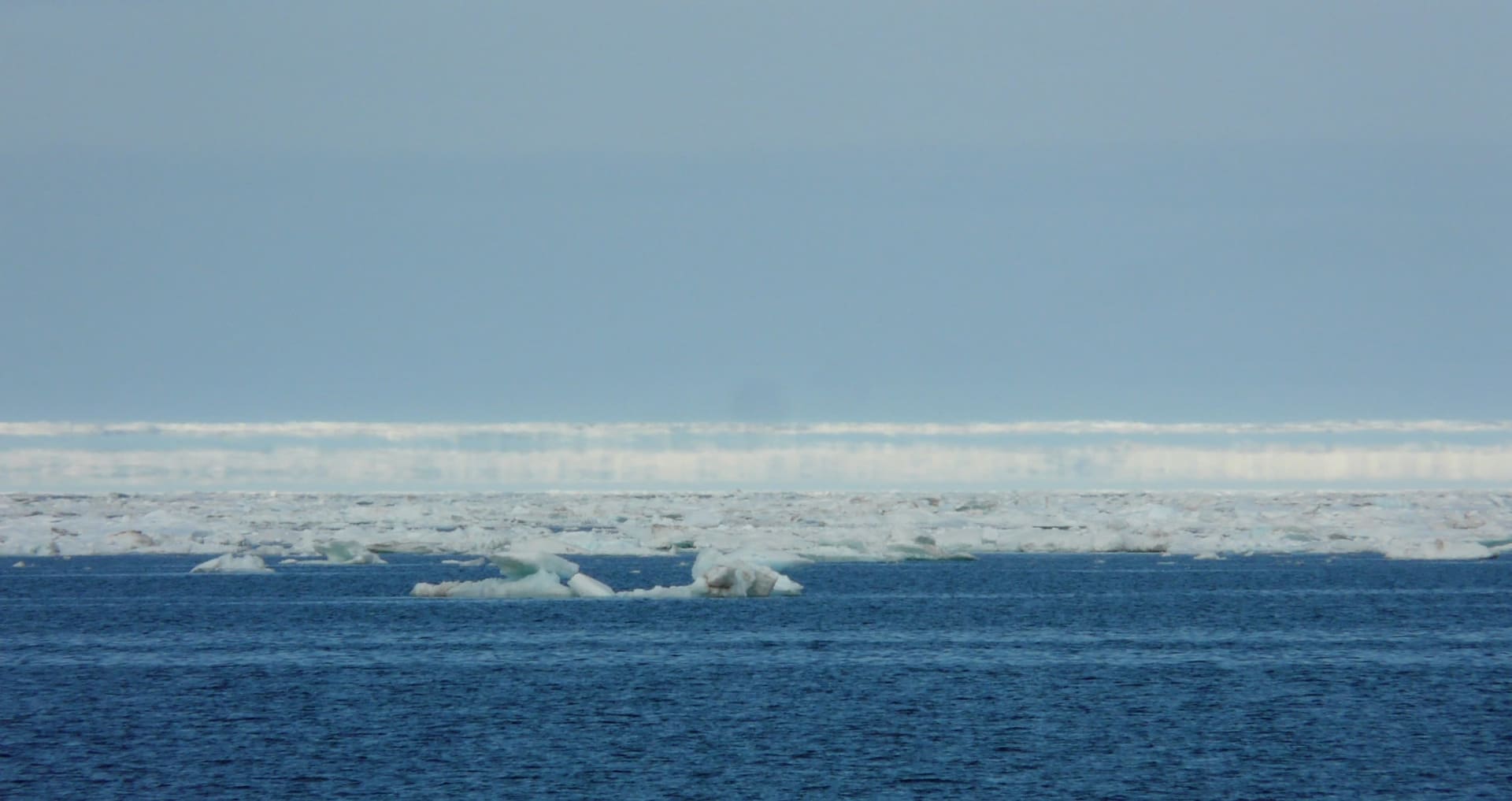
The horizon fractures. What should be a clean line where pack ice meets sky splits into three, then four stacked images, the ice edge repeated, inverted, stretched vertically like a fortress wall rising from the Sea of Okhotsk. From the deck of the Aurora icebreaker or the cliffs above Cape Notoro, you're watching a Fata Morgana unfold, one of nature's most surreal optical tricks. The drift ice season peaks in February, and when temperature inversions lock in place over Hokkaido's northeastern coast, the ice doesn't just arrive. It levitates, multiplies, and warps into forms that confused early polar explorers into charting phantom mountains.
The Science Behind Abashiri's Mirages
Light rays bend when passing through air layers of different temperatures in a steep thermal inversion where an atmospheric duct forms, a refracting lens that produces a series of inverted and upright images. Around Abashiri, the setup is textbook: winter air temperatures range from 0 C to -10 C , but the Sea of Okhotsk beneath the ice retains slightly more warmth, creating a sharp boundary where cold dense air sits atop a layer warmer than expected. A Fata Morgana requires an atmospheric duct to be present. Thermal inversion alone is not enough, though an atmospheric duct cannot exist without a thermal inversion first.
Fata Morgana is most commonly seen in polar regions, especially over large sheets of ice that have a uniform low temperature. Abashiri sits at 44 degrees north latitude (the southernmost point where the ocean freezes), making it one of the most accessible places on Earth to witness superior mirages over sea ice. The drift ice itself originates far north: the Amur River traverses China and Russia before emptying into the Sea of Okhotsk, and the frozen mass of freshwater and saltwater then spreads south. By late January, that white expanse reaches Hokkaido's shore, and with it, the atmospheric conditions that make mirages ignite.
A Fata Morgana may be described as a very complex superior mirage with more than three distorted upright and inverted images. Because of constantly changing atmospheric conditions, it may change within seconds, including shifting back to a straightforward superior mirage. One moment the ice edge towers; the next it compresses into bands. Distant ships (seal-watching vessels or fishing boats) appear suspended mid-air, or duplicated, one hull right-side-up and another flipped above it. Fata Morgana mirages are visible to the naked eye, but to see detail within them, it's best to view through binoculars, telescope, or telephoto lens.
When and Where to See the Drift Ice Mirage
The drift ice season in Abashiri runs from mid-January to late March, with official icebreaker cruises operating January 20 to March 31, 2026. For mirages, narrow your window: February is peak month, when ice coverage is thickest and temperature inversions most stable. Morning hours are critical, from dawn to mid-morning, before the sun warms the lower atmosphere and collapses the temperature gradient. Calm, clear conditions amplify the effect; wind stirs the air layers and breaks the mirage apart.
Abashiri Port, Drift Ice Cruise Boarding (44.0230802, 144.2846025): The Aurora Sightseeing Boats depart from Abashiri Port and travel out into the Sea of Okhotsk to where ice is more likely to be found, because drift ice is not always visible from the coast. From the observation deck of the Aurora, you're positioned at the perfect altitude within the atmospheric duct to catch mirages forming over the ice field. Boat rides take about an hour and run several times daily during the season.
Cape Notoro Viewpoint (Monbetsu) (44.1130647, 144.2433784): An elevated coastal platform offering sweeping views north and east across the ice. The height advantage here often places you above the inversion layer's lower boundary, ideal for catching towering or looming effects where distant ice or ships appear elevated.
Shiretoko, Rausu Coast Viewpoints (44.1996561, 145.2396745): Farther east along the Shiretoko Peninsula, Rausu's coast faces the ice flow head-on. Viewpoints here are more remote, accessed via Route 334. The backdrop of Shiretoko's peaks adds drama. On exceptional mornings, you might see both the ice mirage and distant mountains distorted simultaneously.
Access: Fly to Memanbetsu Airport (MMB), then take the limousine bus to Abashiri Bus Terminal (40 minutes). From there it's a 10-minute walk to the Aurora terminal. From Sapporo, take the JR Limited Express Okhotsk to Abashiri (about 5.5 hours), then taxi or walk to the port. Rent a car for flexibility between coastal viewpoints. Drift ice is not seen every day because it is always moved by wind and tide. Even on the same day, the position may change in a short time depending on sea conditions. Check the Aurora cruise website for real-time ice status.
Your Witnessing Guide
Gear: Pack a camera with telephoto lens (200mm minimum; 400mm ideal for detail). Bring a sturdy tripod, because even on a ship's deck, stabilization helps during mirage sequences. ISO 200-400, aperture f/5.6 to f/8, shutter speed 1/250 or faster to freeze the mirage before it shifts. Shoot in RAW; the subtle gradients in stacked images benefit from post-processing latitude.
Binoculars (8x42 or 10x50) let you track fine structure: the compressed bands, the inverted duplicates. If you're lucky, you might see Steller's sea eagles and seals , and binoculars double for wildlife spotting.
Clothing: Average winter temperature in Abashiri is 0 C to -10 C, and it gets colder on the sea. Layer aggressively: base thermal layer, insulating mid-layer (fleece or down), windproof and waterproof outer shell. Waterproof insulated boots with grip for iced surfaces. Neck gaiter, insulated gloves (bring spares), wool hat. There is a heater inside the ship, but most passengers see the view from outside. You'll spend long stretches on the observation deck in wind chill; hypothermia is real.
Bring spare camera batteries in an interior pocket, since lithium-ion cells drain fast in sub-zero conditions. A thermos of hot tea or coffee keeps core temperature stable during multi-hour observation windows.
Timing: Board the earliest departure available. In February, Aurora cruises depart at 9:30, 11:00, 12:30, 14:00, and 15:30. The 9:30 slot gives you the best light and the coldest, most stable inversion. There is no time during the day when you can see drift ice with high probability , but mornings statistically favor mirage formation.
Safety: Stay on designated platforms and cleared walkways. Sea spray freezes on railings and decks; one slip can mean serious injury. The ship may roll depending on sea conditions on the day, and the operator does not provide seasickness medicine, so prepare your own. Do not approach the ice edge on foot if you venture to shore viewpoints; the pack ice is unstable and can fracture without warning.
Why the Mirage Matters
Superior mirages are more than optical curiosities. They're atmospheric diagnostics, revealing the thermal structure of the lower atmosphere with precision no instrument can match from afar. For centuries, polar explorers misread Fata Morganas as real geography. In 1818, British explorer John Ross saw a mountain blocking Lancaster Sound and named it the Croker Mountains, but a later expedition showed they did not exist. In 1906, American explorer Robert Peary viewed Crocker Land northwest of Ellesmere Island; years later, Donald MacMillan chased the frozen apparition for five days before realizing it was an illusion. Abashiri's mirages connect you to that history of wonder and confusion.
The drift ice is losing strength year by year due to the effects of global warming , a trend documented by the Japan Meteorological Agency. Warmer winters thin the ice, shorten the season, and destabilize the temperature inversions that produce mirages. As of early 2026, the ice still arrives reliably, but long-term projections suggest a future where February ice becomes intermittent. The mirage phenomenon may outlast the ice itself (superior mirages can form over open water), but the spectacle of stacked, towering ice fields will diminish.
The drift ice ecosystem supports phytoplankton blooms in spring that feed the entire Sea of Okhotsk food web. Steller's sea eagles, spotted seals, and ribbon seals depend on the ice edge for foraging and rest. When the ice retreats earlier or arrives thinner, those species face caloric deficits at critical breeding times.
Culturally, the drift ice defines Hokkaido's Okhotsk coast. The Abashiri Okhotsk Drift Ice Festival, held February 7-8, 2026, at Abashiri Commercial Port, features food stalls, performances, and illuminated ice sculptures. The festival frames the ice as both natural wonder and cultural anchor, a reminder that ephemeral phenomena shape identity as much as permanent landmarks.
Track live ice and weather conditions for Abashiri Drift Ice Mirage and 940+ other phenomena on the Earth Exhibit app: https://earthexhibit.com
The Abashiri drift ice mirage is a convergence: sea ice meeting atmosphere, light meeting temperature gradient, natural process meeting human perception. It lasts minutes to hours, reappears on select mornings across a six-week window, and may not look the same twice in a single day. That fragility is the point. The uncertainty itself is what draws you.
This is the short version
This page shows a taste. The app has the full list of where to see this, the exact timing, and live conditions for 1,000+ natural phenomena worldwide, so you know the moment one is genuinely worth the trip.